Most blog posts fail before anyone reads the second paragraph. Not because the topic is bad, but because the writing was never built for how people — and search engines — actually consume content in 2026. Learning how to write SEO friendly content is the skill that separates pages that rank from pages that sit invisible on page eight.
This guide gives you a complete, repeatable workflow: match search intent, map the entities your topic needs, structure for skimmers and snippets, write readable human-first prose, weave in E-E-A-T signals, and finish with a pre-publish checklist. It also covers what most competing guides miss entirely — writing so AI Overviews cite you, using a 40-word definition technique for featured snippets, and treating “refresh” as part of the writing process, not an afterthought.
Think of this page as your field manual for how to write SEO friendly content.
What “SEO Friendly” Actually Means in 2026
SEO friendly content is content written so both readers and search engines can instantly understand what it covers, who it is for, and why it deserves to rank. It matches the searcher’s intent, answers the query fast, covers the topic completely, reads easily, and carries visible signals of real expertise.
What changed: keyword density is dead as a tactic. Google’s systems now reward content that demonstrates first-hand experience, covers related entities (not just repeated keywords), and is structured so answers can be extracted — by featured snippets and by AI Overviews. If your article cannot be quoted in one clean sentence, it is harder for every modern surface to use it. That is the new bar, and everything below is built around clearing it.
Step 1 — Start With Search Intent, Not Keywords
Before you type a word, figure out what the searcher actually wants. Google ranks pages that satisfy intent, not pages that repeat a phrase the most times. There are four intents, and each one wants a different article shape:
- Informational (“how to write SEO friendly content”) — wants a guide or tutorial. Teach, step by step.
- Commercial investigation (“best SEO writing tools”) — wants comparisons and honest trade-offs. Compare, don’t just list.
- Transactional (“hire SEO content writer”) — wants to act. Make the next step obvious.
- Navigational (“ssaagency blog”) — wants a specific page. Don’t try to rank guides here.
The fastest intent check: Google your target keyword and look at page one. If the top results are step-by-step guides, write a better step-by-step guide — not a listicle, not an opinion piece. Format mismatch is the number one reason well-written articles never rank. For the research side of this step, our walkthrough on how to do keyword research shows how to validate demand before you commit to a draft.
Step 2 — Map Entities and Questions Before You Write
Old SEO writing started with a keyword list. Modern SEO writing starts with a coverage map. Google understands topics as networks of entities — people, tools, concepts, and questions connected to your subject. An article about SEO friendly content that never mentions search intent, readability, E-E-A-T, or meta descriptions looks thin to both readers and algorithms, no matter how many times it repeats the keyword.
Build your map in ten minutes:
- Open Google’s “People Also Ask” box for your keyword and copy every question. Each one is a subheading candidate.
- List 5–8 entities a genuine expert would mention (tools, metrics, related concepts). If you cannot name eight, research more before writing.
- Note the questions your competitors’ articles leave unanswered. Those gaps are your fastest wins.
This is the “expert test”: read your outline and ask whether a real practitioner would nod along. If the outline could have been written by someone who never did the work, the draft will read that way too — and readers bounce, which is a signal you never want to send. That practitioner-level depth is what separates a genuine guide on how to write SEO friendly content from a generic listicle.
That coverage map is the research engine behind how to write SEO friendly content.
Step 3 — Structure Every Article for Skimmers and Snippets
Nobody reads top to bottom anymore. Readers skim headings, and Google extracts answers. One structure serves both masters:
- Open with a 40-word definition block. Right after the intro, define the topic in about 40 words. This is the exact length Google loves to lift into featured snippets and AI Overviews. Write it as a clean, quotable statement — no throat-clearing.
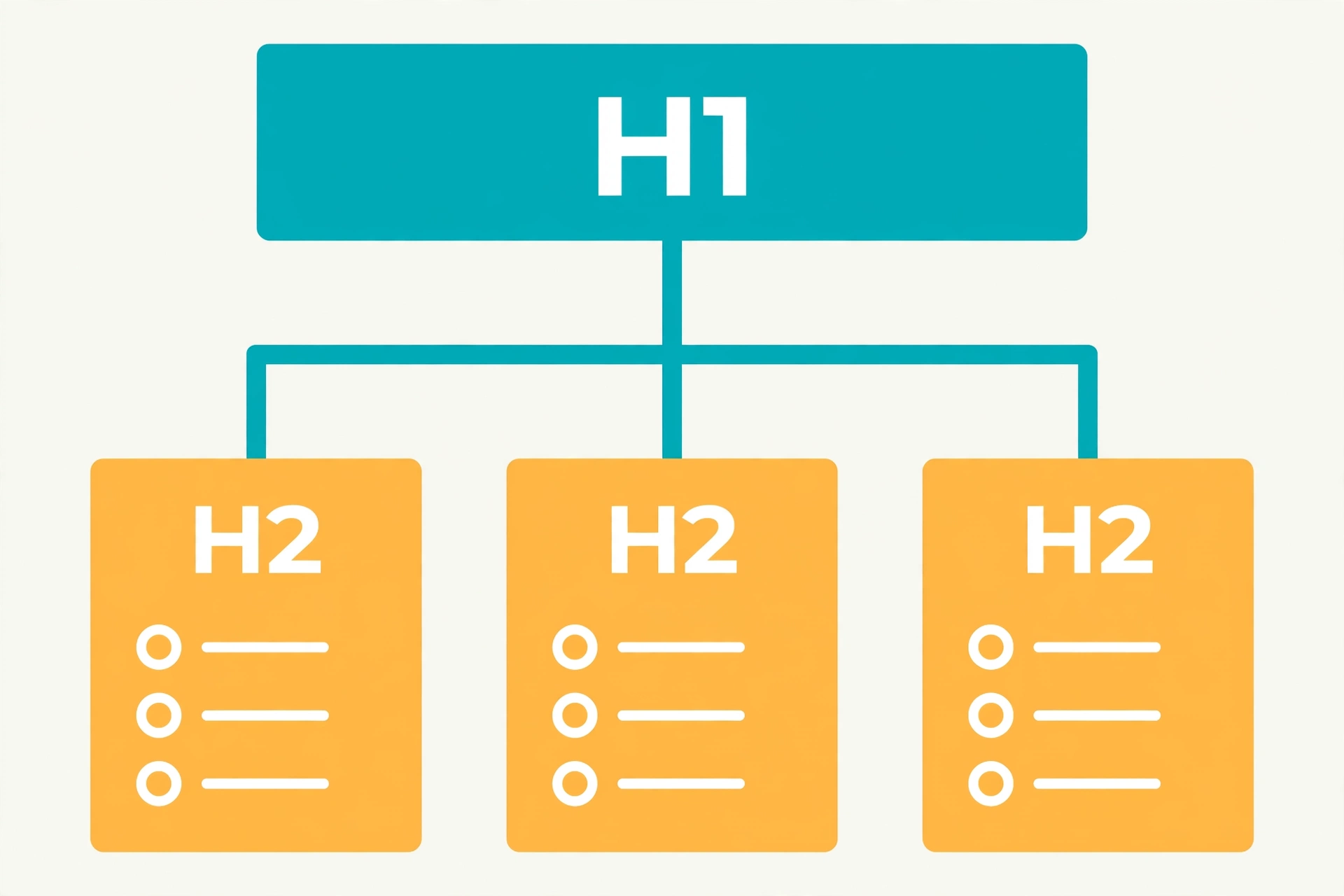
- One H1, descriptive H2s, H3s for detail. Each H2 should work as a standalone answer to a question. A reader who only reads your headings should still learn something.
- Lists and tables over paragraphs for anything comparative, sequential, or multi-part. Steps, pros and cons, and checklists belong in lists.
- Short paragraphs — two to three sentences. A wall of text is a bounce waiting to happen, especially on mobile.
- End sections with the takeaway. One crisp sentence that states what the reader should do or remember.
Put your most important answer early — ideally in the first third of the article. Both impatient readers and answer-extraction systems reward front-loaded value.
Front-loading value is a signature move in how to write SEO friendly content.
Step 4 — Write for Humans First (Readability Rules That Rank)
Here is the uncomfortable truth most SEO guides dance around: the best-optimized article in the world still fails if people won’t read it. Google measures what readers do — bounce back to the results, and your rankings quietly bleed. Readability is not decoration; it is a ranking input by proxy.
Four rules keep prose readable:
- Budget 15–20 words per sentence on average. Short sentences land points. Longer ones explain nuance. If three long sentences stack up, break one.
- One idea per paragraph. When the idea changes, hit enter. White space is a feature.
- Prefer active voice and concrete verbs. “Google rewards clear writing” beats “clear writing is rewarded by Google” every time.
- Aim for a Flesch Reading Ease score of 60+. You do not need a tool for every draft — but run one on your first few articles until the rhythm becomes habit.
Then do the read-aloud test: read the draft out loud. Any sentence you stumble over gets rewritten. Any sentence that sounds like a robot wrote it gets rewritten twice. Natural, conversational prose is what both readers and modern language models prefer — keyword stuffing reads as spam to humans long before an algorithm flags it.
Readable prose is the foundation everything else in how to write SEO friendly content rests on.
Step 5 — Weave E-E-A-T Into the Draft Itself
E-E-A-T (Experience, Expertise, Authoritativeness, Trustworthiness) is not a badge you claim in the author bio and forget. The strongest signals live inside the writing:
- Show first-hand experience. “When we audited 40 client blogs, the pattern was…” beats “Studies show…” every time. Specifics — numbers, timeframes, mistakes you made — are nearly impossible to fake and readers can feel the difference.
- Cite real sources. When you state a fact, link the primary source. A guide that links Google’s own documentation for algorithm claims instantly outranks one that asserts the same claims with no evidence. For example, Google’s guidance on creating helpful content is the canonical reference for what “quality” means to the search team.
- Name the author and their credentials. A visible author bio with real expertise turns an anonymous article into a trustworthy one — see our breakdown of author bio SEO best practices for the exact elements to include.
- Admit limits. “This works for blogs; for product pages the calculus differs” builds more trust than universal claims. Nuance is an expertise signal.
Generic advice is the enemy here. If a section could appear unchanged in any competitor’s article, it is not demonstrating expertise — rewrite it with your angle, your data, or your example. That is how to write SEO friendly content that carries real authority instead of borrowed claims.
Original experience is what separates genuine guides on how to write SEO friendly content from rewrites.
Step 6: How to Write SEO Friendly Content That Gets Cited by AI Overviews
This is the step competing guides skip, and in 2026 it matters enormously. AI Overviews now answer a huge share of informational queries without a click — but they cite sources. Getting cited sends qualified traffic and builds authority even in a zero-click world. Write to be quotable:
- Write self-contained answer sentences. Each key claim should work as a standalone quote: subject, verb, complete thought. “SEO friendly content matches search intent before it targets keywords” can be lifted cleanly; “It is really important for the aforementioned reasons” cannot.
- Put data near the claim. “Pages with a clear definition block win featured snippets 2–3x more often in our client sample” is citable. Vague superlatives are not.
- Use precise entity names. Say “Google’s AI Overviews,” not “the new AI thing.” Disambiguated entities are easier for systems to attribute.
- Keep one clear answer per section. When a section tries to answer three questions, an AI summary picks none of it confidently.
You cannot control whether an AI cites you, but you can control whether your writing is built to be cited. Most content is not — which is exactly why this is an opening.
Write every section as if an AI might quote it — that is how to write SEO friendly content for 2026.
Step 7 — Run the Pre-Publish Checklist
Great drafts die on sloppy publishing. Before anything goes live, verify the mechanics. This is also where a content brief writers actually follow pays off — compare the draft against the brief and confirm every promised subtopic made it in.
- Keyword placement: exact keyword in the SEO title, meta description, URL slug, H1, first 100 words, and at least one H2. Natural everywhere — never forced.
- Meta description: 150–160 characters, keyword included, written as a reason to click, not a summary.
- Internal links: at least two links to relevant pages on your own site, placed where a reader would genuinely want them — see internal linking best practices for anchor-text rules.
- External links: one or two links to authoritative sources (official docs beat blog roundups), set to open in a new tab.
- Images: every image has descriptive alt text containing the keyword or a natural variation; files are compressed (WebP preferred).
- Read-aloud pass: one final read for rhythm, repetition, and robot-speak.
If any item fails, fix it now. Publishing a 90%-ready article and “fixing it later” is how content decays before it ever ranks.

Step 8 — Publish, Then Refresh (Writing Isn’t Finished at Publish)
Here is what almost no “how to write” guide tells you: the publish button is the midpoint, not the finish line. Rankings shift, facts age, and competitors improve their articles. The writers who win treat every article as a living document with a refresh date already on the calendar.
Set a 6-month review reminder for every important article. On review day, check rankings in Search Console, update statistics and examples, fill any new People Also Ask questions, and tighten sections readers skip. Our guide on how to fix content decay walks through the full refresh workflow — teams that run it routinely see refreshed pages climb back up within weeks.
Schedule the refresh before you publish — that discipline completes how to write SEO friendly content.
5 Mistakes That Kill SEO Friendly Content
- Writing for the keyword, not the question. If the article answers a query nobody asked, perfect optimization just helps the wrong page rank for nothing.
- Keyword stuffing in 2026 clothing. Repeating the phrase in every heading “naturally” is still stuffing. Use variations and related terms.
- Walls of text. Five-sentence paragraphs on mobile are a bounce machine. Break them up.
- Zero internal links. An article with no links to your own site is an island — no authority flows in, and readers have nowhere to go next.
- Publish and forget. Content left untouched for two years quietly rots while competitors refresh. Schedule the revisit before you publish.
Frequently Asked Questions
How long should SEO friendly content be?
As long as the query demands — no longer. Quick answers can win in 600 words; competitive guides usually need 1,800–2,500. Match the depth of page one, then go one level deeper on the weakest section. Padding word count without adding value hurts more than it helps.
How many times should I use my target keyword?
Enough to be clear, not enough to notice. Put it in the title, URL, meta description, H1, intro, and one H2, then use natural variations and related terms. If you can hear the repetition when reading aloud, you have overdone it.
Can AI write SEO friendly content?
AI drafts the scaffolding well but cannot supply the parts that rank hardest: first-hand experience, original data, and genuine judgment. Use AI for outlines and first drafts, then add your experience, examples, and sources — that human layer is the competitive moat.
What is the difference between SEO writing and copywriting?
SEO writing aims to rank and inform; copywriting aims to persuade and convert. Great content often does both, but the primary job differs — which is why the roles need different skills. We break down the full comparison in SEO content writer vs copywriter.
How do I know if my content is actually working?
Watch three things in Search Console over 60–90 days: impressions climbing (you are entering the conversation), average position improving (relevance is landing), and clicks following (your titles earn the visit). Impressions without clicks means fix the title and meta, not the article.
Should I update old content or write new articles?
Both, but update first — it is usually faster. A decaying page with existing authority often recovers with a focused refresh, while a brand-new page starts from zero. Audit quarterly and refresh anything sliding before you expand into new topics.
Conclusion
Learning how to write SEO friendly content comes down to a repeatable system, not talent: match intent, map entities, structure for skimmers and snippets, write readable human prose, bake in E-E-A-T, write to be cited, check the mechanics, and refresh on schedule. None of these steps is hard on its own — the advantage goes to writers who run all of them, every time.
Master this system and you will never again wonder how to write SEO friendly content.
Pick one article you have already published and run it through the checklist in Step 7 this week. You will find at least three fixes in under an hour, and those small fixes compound across every page on your site. That is how content starts ranking — not with tricks, but with better writing, done consistently.