Most car buyers research online for weeks before stepping onto a lot — increasingly through AI tools as well as search. If your dealership is invisible during that window, you lose the sale before a salesperson ever gets a chance. If you run a dealership, seo for car dealerships is not optional anymore — it is the system that puts your inventory, your reviews, and your service department in front of buyers at the exact moment they decide where to buy.
This playbook covers the eight steps that move rankings and lead volume for dealerships in 2026 — including a 10-point scoring rubric for your vehicle pages, a feed-integrity protocol, and a plan to get cited by AI search tools, not just ranked by Google.
Work through all eight steps and seo for car dealerships becomes your highest-ROI channel instead of a cost center.
Why SEO for Car Dealerships Is a Different Game
Dealership SEO breaks most of the normal rules, and that is exactly why generic SEO advice fails here. Five things make this industry unique:
- Your inventory expires. A used car can sell in seven days — every dollar invested in ranking that exact page evaporates when it drives off the lot.
- Marketplaces outgun you. CarGurus, Cars.com, Autotrader, and Carfax are engineered to rank for literal vehicle searches like “used 2022 Honda Civic in Austin.” An independent lot cannot out-optimize them head-on.
- Your platform can sabotage you. Many dealer platforms render inventory through JavaScript. A page that looks complete to a human can be empty to a crawler that cannot run that script — including AI crawlers.
- Most of your traffic already knows you. On typical dealer sites, the large majority of clicks come from branded searches — people typing the dealership’s name. They are not browsing; they are deciding whether to trust you.
- You run two businesses. Sales and service attract different searches, different customers, and different Google categories. Treating them as one SEO project wastes half your opportunity.
Once you accept these realities, the strategy writes itself: stop fighting marketplaces for individual VINs, build pages that outlive any single car, make inventory readable by every crawler, and run service as its own SEO engine.
SEO for Car Dealerships: The 8-Step Playbook for 2026
Step 1: Win the Map Pack Before Anything Else
Every serious seo for car dealerships plan starts at the map pack, because “used cars near me” and “car dealerships near me” show local results before anything else. Your Google Business Profile is the highest-leverage asset you control.
- Set the right primary category (Car Dealer, Used Car Dealer, or Truck Dealer — not a generic retail category) and add every relevant secondary category, from financing to trade-in appraisals.
- Keep hours accurate, including holiday exceptions. Mismatched hours are a quiet killer of calls.
- Upload fresh photos of your lot, showroom, and service bay every month. Real lot photos beat stock imagery.
- Answer every question in the Q&A section yourself before a competitor or a confused shopper does.
- Post 4 to 6 times a month on rotation: body styles in stock, service offers, reviews, one CTA per service.
- Run a citation audit and fix name, address, and phone mismatches everywhere — our NAP consistency guide walks through the process.
Reviews get their own system in Step 6 — but start now: respond to every review, including negative ones, within 48 hours.
A dominant map-pack presence is the fastest single win in seo for car dealerships.
Step 2: Build VDPs That Sell, Not Just Rank
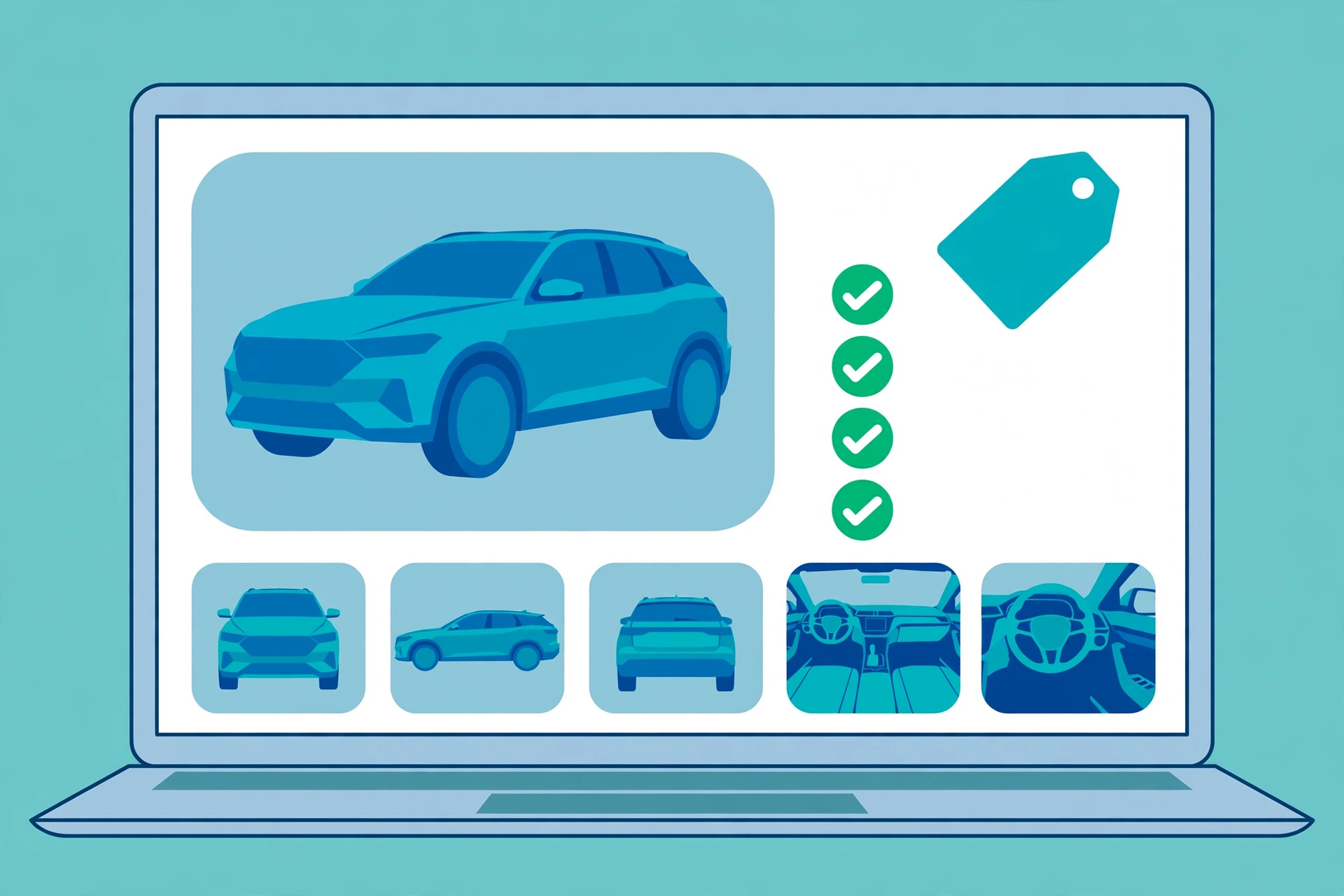
Your vehicle detail pages (VDPs) are where shoppers decide. Thin, templated VDPs cap every other SEO effort — a page with an OEM description and stock photos converts nobody and ranks nowhere. Score every VDP against this 10-point rubric:
- A unique 150+ word description written like someone who knows cars — real numbers (EPA mileage, tow ratings), not keyword-stuffed filler.
- Twenty or more real photos of the actual vehicle, not stock shots.
- The full advertised price, visible above the fold, including mandatory fees. Hiding price behind “Call for Price” gets you filtered out by buyers and AI tools alike.
- A trade-in estimator embedded on the page.
- A payment calculator so shoppers can self-qualify without waiting for a callback.
- A test-drive or appointment scheduler above the fold.
- Schema markup (Vehicle type) with price, mileage, VIN, condition, availability, model year, and body type.
- Clean, descriptive URLs (make, model, year, trim) instead of database IDs.
- Canonical tags so near-duplicate listings do not split your authority.
- A fast, mobile-clean layout — check on your own phone that content appears before scrolling.
Build one VDP template that hits all ten, then roll it across inventory. Template the structure, never the words: duplicate manufacturer descriptions are the most common reason dealer VDPs fail to rank. Keep pages fast too — our Core Web Vitals guide covers the benchmarks that matter.
Step 3: Fix the Inventory Feed
Treat your inventory feed as a product, not a one-time export — stale data is the fastest way to lose Google and AI referrals. Run this protocol weekly:
- Sold-car purge: remove sold vehicles from the live site within 24 hours. Thousands of dead listing URLs sitting live burn crawl budget and frustrate shoppers.
- Price and VIN reconciliation: schema price, mileage, and VIN must match what is on the lot — mismatches erode the trust signals Google and AI use.
- Indexability check: every VDP must be reachable without a login or search form. If your platform gates inventory behind JavaScript crawlers cannot execute, that is a platform emergency.
- Feed sync: sync inventory data in real time so marketplaces, Google, and AI tools never surface a sold vehicle or wrong price.
- Quarterly crawl: run Screaming Frog or Search Console’s URL inspection to catch blocked feeds, missing canonicals, and robots.txt rules accidentally hiding inventory.
Dealers who treat feed accuracy as infrastructure win the compound effect: every other step performs better on clean data.
Clean inventory data is the backbone of every successful seo for car dealerships program.
Step 4: Build Body-Style Pages, Not Make-and-Model Pages
The structural insight most dealers miss: a “2022 Honda Odyssey” page has a one-week lifespan, while a “minivans for sale in [city]” page is a durable asset backed by every minivan you will ever stock. Build around body styles and intents that persist:
| Search intent | Page that should own it |
|---|---|
| Used car dealership + city | Homepage or primary local page |
| Used cars / trucks / SUVs for sale + city | Body-style inventory landing page |
| Buy here pay here + city | Dedicated financing page |
| Auto repair + city | Service landing page |
| Year / make / model for sale | Vehicle detail page |
| Model comparison (e.g., Civic vs. Corolla) | Comparison content page |
Each body-style page needs real local content plus your actual inventory displayed on it. Never build pages for body styles you do not sell. And do not confuse this with blogging: a “what is a doc fee” post is top-of-funnel content, while a body-style page is targeted local SEO. Use proper keyword research to map each page to the exact phrases your market types.
Step 5: Run Fixed Ops as a Second SEO Engine
This is why seo for car dealerships always has a second engine: your service department. Searches like “oil change near me” or “brake repair [city]” are high-intent, often less competitive than sales keywords, and they bring customers who later buy cars from you.
- Run two Google Business Profiles: one for sales, one for service, each with the matching primary category and each linking to the page that matches its category. Google decides which side of your business to trust based on that primary category.
- Build service-menu pages: one real page per service (oil changes, brake repair, inspections, tires) with pricing ranges, how-long-it-takes details, and an appointment scheduler.
- Add scheduler schema so booking actions can surface directly in search results.
- Publish technician proof: certified-technician bios, real service FAQs written from questions your advisors actually hear, and before/after photos of real work.
- Collect service-specific reviews and respond to them separately from sales reviews.
Fixed-ops SEO compounds beautifully: a customer who finds you for a $60 oil change is a future $30,000 vehicle buyer who already trusts your shop.
Step 6: Earn Reviews on Autopilot
Review volume and response rate function as real ranking signals, not just trust signals — and review text increasingly feeds the AI answers buyers read. Build an ethical, repeatable system:
- Ask at the delivery moment. The highest-converting ask happens when the buyer stands next to their new car, still excited. A QR code scanned on the spot beats a follow-up email three days later.
- Route the request by text. Texted review links convert far better than email for dealership buyers.
- Respond to everything within 48 hours. Positive reviews get a genuine thank-you; negative ones get a calm, specific, non-defensive reply that shows the next reader how you handle problems.
- Never buy, condition, or pressure reviews. Incentivized or fake reviews violate platform policies and can trigger enforcement — and one exposed fake-review scheme costs more trust than a hundred real reviews build.
- Mine reviews for content. The phrases customers use (“easy financing,” “no pressure,” “great service department”) are keyword and FAQ gold. Feed them back into your pages.
Short video testimonials shot on a phone at delivery do double duty: they humanize your site and give YouTube and your profile fresh content. Our video SEO guide shows how to make it rank.
Step 7: Get Cited by AI Search
Industry research finds roughly one in five vehicle buyers now uses AI tools during research — and AI search does not rank pages, it cites sources. To become a cited source:
- Write answer-first content: financing explainers, trade-in guides, service FAQs, and model comparisons in direct Q&A format are what AI summaries quote.
- Keep structured data immaculate. AI tools depend on accurate, structured inventory data to summarize and recommend vehicles. Clean feeds and Vehicle schema matter more in the AI era, not less.
- Get mentioned where AI looks. AI pulls from Reddit, local Facebook groups, forums, and local news — not just your site. Answer car-buying questions in your city’s subreddit, host events that earn press, and sponsor organizations that list your link and logo.
- Publish transparent pricing. AI shopping assistants filter by price visibility. Dealerships hiding behind “Call for Price” get filtered out before the buyer ever sees them.
- Run press releases monthly. Distributed through a PR publisher, they are picked up across news outlets and serve as strong trust signals that AI systems cite.
Step 8: Defend Your Brand SERP and Measure What Matters
Most of your traffic is branded, which makes your brand results page prime real estate — and marketplaces routinely bid on your dealership’s name to poach your customers. Defend it:
- Own the branded SERP: your site, your Google Business Profile, your reviews, and your social profiles should dominate page one for your dealership’s name.
- Seed your GBP Q&A with the questions buyers actually ask, so your answers — not a competitor’s — appear.
- Monitor brand-term ads: if a marketplace outbids you on your own name, a small defensive budget protects your highest-intent traffic.
Then measure outcomes, not vanity traffic: organic leads, tracked calls, booked appointments, VDP-to-contact conversion rate. Set up GA4 events for scheduler starts and click-to-call, tie them to call tracking, and match CRM records back to source. Our Search Console guide shows how to read the query data. Keep attribution simple — last organic click to closed deal.
5 SEO Mistakes Car Dealerships Keep Making
- Duplicate OEM descriptions on every VDP. The manufacturer’s paragraph pasted onto a hundred listings ranks none of them. Write original descriptions or expect no rankings.
- Hiding prices. “Call for Price” does not protect margin; it filters you out of buyer shortlists and AI summaries before the conversation starts.
- Thin city pages. Doorway pages stuffed with city names rank briefly, then get filtered. Build one strong market page with real inventory behind it.
- Ignoring fixed ops. Half the business gets zero SEO attention at most dealerships. Service searches are cheaper to win and feed future sales.
- Chasing rankings instead of revenue. A #1 ranking for a model you no longer stock is worthless. Track leads, appointments, and closed deals — not positions.
Fixing these five mistakes is the fastest way to improve seo for car dealerships without spending an extra dollar.
Your 90-Day Timeline
| Phase | Focus | What gets done |
|---|---|---|
| Days 1–30 | Foundation | GBP fully optimized, citation cleanup, feed-integrity protocol running, one VDP template hitting all 10 rubric points |
| Days 31–60 | Pages | Body-style landing pages live, fixed-ops service pages live, second GBP for service, review workflow installed at delivery |
| Days 61–90 | Authority | Answer-first financing and comparison content, local sponsorship links, press release cadence, measurement dashboard wired to CRM |
Expect local-visibility movement in the first 30 to 90 days from GBP, review, and feed work. Page rankings and AI citations compound over the following months.
Consistency is what makes seo for car dealerships compound — the dealers who win are the ones who keep at it.
Frequently Asked Questions
What is SEO for car dealerships?
SEO for car dealerships is the work of making your dealership show up when a buyer searches for what you sell: used cars in your town, buy-here-pay-here financing, or auto repair near me. On your website, it means real pages for every service and buyer — especially vehicle detail pages and body-style landing pages. Off your website, it means your Google Business Profile, listings, reviews, and the links proving you are a real local business.
How long does SEO take for a car dealership?
Think in phases. GBP fixes and a working review system often move local visibility within 30 to 90 days. Technical work — schema, feed accuracy, new pages — compounds over three to six months. Dealerships that skip the foundation and buy ads instead pay to send traffic to pages that cannot convert.
Should we publish prices on our dealership website?
Yes. Buyers and AI tools filter dealerships by pricing visibility, and hidden prices read as a trust red flag. Transparent, fee-inclusive pricing keeps you in AI summaries, builds trust, and keeps you clear of pricing-transparency scrutiny on auto advertising.
How do we compete with CarGurus and Cars.com?
Do not fight them for individual vehicle searches. Win the fights they cannot: branded searches, map-pack presence, body-style plus city pages, your service department, and your local reputation. Marketplaces cannot replicate your profile, your reviews, or your community presence.
Do we need a separate website for our service department?
Not a separate website, but yes to a separate Google Business Profile and dedicated service pages. Give the service profile the matching category and point it at your service landing page, so Google surfaces the right side of your business for repair versus sales searches.
Is SEO worth it for car dealerships now that AI search exists?
Yes — but the definition has expanded. Traditional rankings still drive most dealer traffic, while AI citation, AI Overviews placement, and structured data now matter alongside them. The same work feeds both: accurate feeds, Vehicle schema, answer-first content, and real local authority are exactly what AI tools cite.
Conclusion
That is seo for car dealerships in 2026: win the map pack, build VDPs that sell, keep your feed immaculate, rank body-style pages that outlive any single car, run service as its own engine, earn reviews on autopilot, get cited by AI, and defend the brand searches you own. No franchise budget required — just consistency, real content, and clean data.
Want to know exactly where your dealership stands today? Get a free SEO audit and we will score your VDPs, your feed, and your map-pack presence against this playbook — then show you the highest-leverage fixes first.