Your rankings are climbing and organic traffic is up, but the phone is not ringing any faster. That gap is exactly what seo conversion optimization closes: turning search visitors into quote requests, booked calls, and paying clients instead of just pageviews. A 1% improvement in conversion rate often produces more revenue than a 30% jump in traffic. This playbook covers the full system — a 60-minute traffic-to-lead audit, the landing-page levers that move the needle, lead-quality tracking, and the 5-minute response rule that decides whether a lead becomes a client.
Why SEO Traffic Doesn’t Convert for Service Businesses
Most service businesses measure SEO success in rankings and sessions. Both are useful, but neither pays the bills. A typical leak looks like this: the site ranks well for informational keywords, visitors arrive with a research mindset, and the page gives them no clear reason or path to become a lead. They read, they leave, and the traffic never enters a pipeline. Without seo conversion optimization, even strong rankings fail to produce pipeline.
There are five recurring culprits. Intent mismatch — the page answers “how does X work” when the visitor’s wallet is closed. Weak CTAs — a “Contact Us” link in the footer asks for commitment without offering anything. Missing trust signals — no reviews or credentials where the decision happens. Friction — slow pages, long forms, no click-to-call on mobile. And broken tracking — the business cannot see which pages generate leads, so it keeps funding content that entertains instead of content that converts — and each of these is a fixable seo conversion optimization problem.
Before fixing anything, understand the formula you are optimizing: monthly organic visitors × conversion rate = leads, and leads × close rate × average job value = revenue from SEO. Every lever in this playbook moves one of those variables.
SEO Conversion Optimization: What It Actually Means
SEO conversion optimization is where two disciplines overlap. SEO brings qualified visitors from search; conversion rate optimization turns them into enquiries. Treat them as one system: pages that convert well earn stronger engagement signals, and better engagement supports visibility.
For a service business, a “conversion” is rarely a purchase. It is a macro-conversion (quote request, consultation booking, phone call) or a micro-conversion (pricing page view, case-study download, return visit). Micro-conversions warm an informational visitor into a transactional one — and they are the part most service sites never measure, which is why their analytics show traffic but no pipeline.
A healthy benchmark: service websites typically convert 2–5% of organic visitors into enquiries. Below 2%, fixing conversion mechanics beats buying more traffic almost every time. And SEO spend only pays off when traffic converts — which is why understanding how much SEO actually costs matters before you scale either side of the equation.
The 60-Minute Traffic-to-Lead Conversion Audit
Do not start with tactics. Start with diagnosis, using data you already own in Google Search Console and Google Analytics 4.
Step 1: Find the money pages (15 minutes)
In GA4, list your top 20 organic landing pages and flag the ones that should produce enquiries: service pages, location pages, pricing pages, case studies. If your top-traffic pages are all blog posts while service pages languish, you have a distribution problem, not a traffic problem. Fixing that distribution is one of the quickest seo conversion optimization wins available.
Step 2: Score each money page on four conversion dimensions (25 minutes)
Give every money page a 0–2 score per row and sum them. Anything scoring under 5 is a rebuild candidate before you write another blog post.
| Dimension | 0 — leaking | 1 — okay | 2 — converting |
|---|---|---|---|
| Message match | Headline unrelated to the search query | Topically related but generic | Headline mirrors the query + service + location |
| CTA visibility | CTA only in footer or bottom | One CTA above the fold | CTA above fold, mid-page, and bottom — same next step |
| Trust at decision point | No proof near CTA | Reviews somewhere on page | Rating, count, and credential adjacent to every CTA |
| Friction | Long form, slow mobile load, no click-to-call | Form under 6 fields OR fast load | Short form + click-to-call + sub-2.5s mobile LCP |
Step 3: Identify the query-to-page gap (20 minutes)
In Search Console, filter your money pages by queries with high impressions but low CTR or conversions. A page ranking for “emergency plumber near me” that converts at 0.5% usually suffers from message mismatch — the visitor expects an emergency offer and sees a generic page. Match the page to the query’s intent.
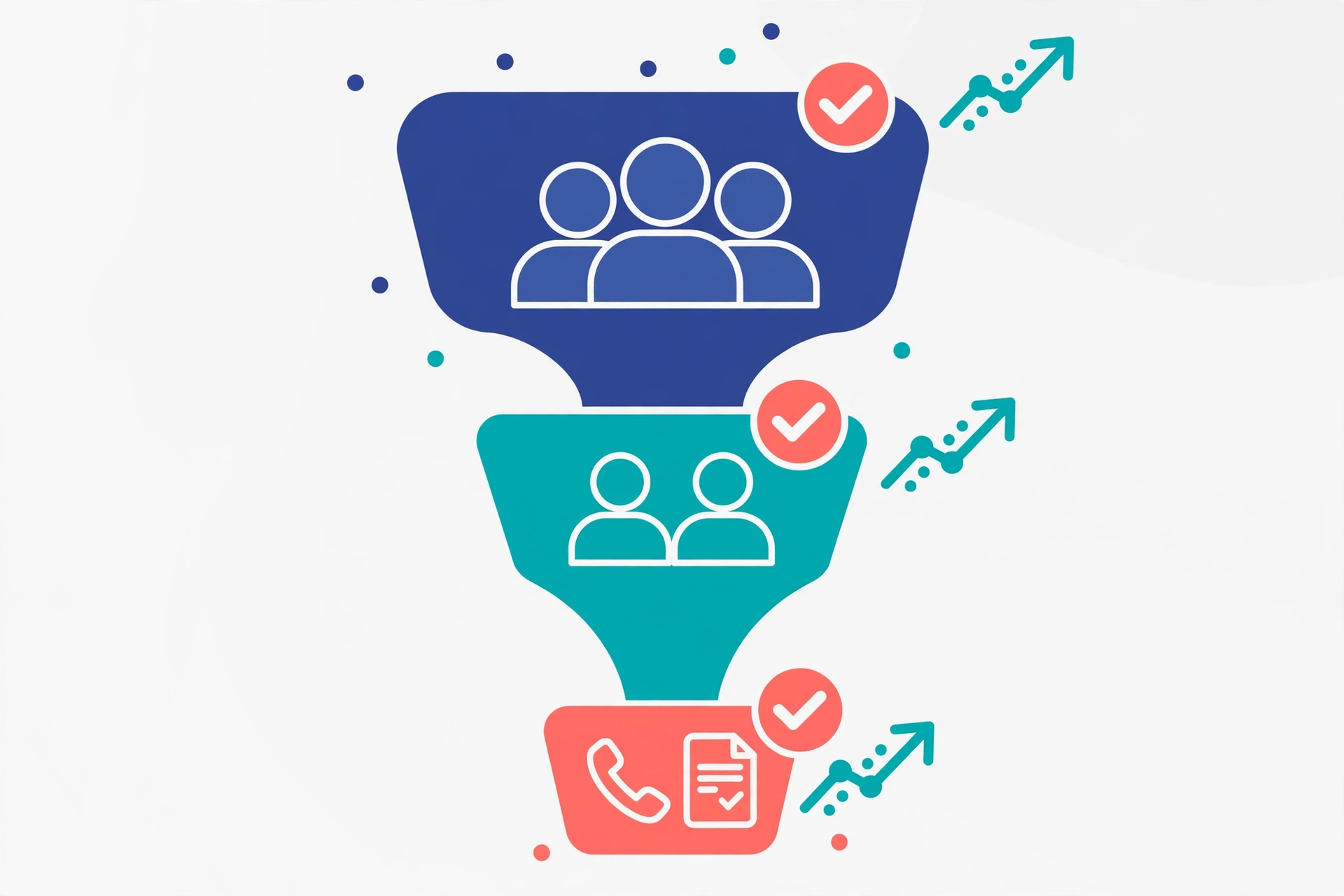
The Conversion Playbook: 8 Levers for Service Businesses
Work these levers in order. The first four fix the majority of leaks for most service sites; together, they form a complete seo conversion optimization system.
1. Match every page to search intent, not just keywords
Visitors using transactional phrases like “book,” “quote,” “near me,” or “pricing” are ready to act — give them service pages with immediate booking options, never a blog post. Informational visitors need education first; serve the answer, then bridge them with a soft CTA like a free checklist or cost calculator. Mapping keywords to funnel stage fixes the root cause of most leaks: the wrong offer shown to the right visitor. Get this right and the rest of your seo conversion optimization effort compounds.
2. Rewrite the top of the page (above the fold)
The first screen should confirm the search, state the outcome, and offer one next step: a keyword-matched headline (“Plumbing Repairs in Austin — Same-Day Service”), one line stating the outcome (“Fixed today, guaranteed in writing”), and one CTA button plus a click-to-call option. Remove firm history from the hero — nobody converts on a founding story.
3. Place trust signals where decisions happen
Reviews in a footer tab convert nobody. Put your Google rating and review count directly beside every CTA, credentials in the bio block, and one short client testimonial within the first two scrolls of service pages. Case studies with specific outcomes beat vague claims every time — and most local-service buyers read reviews before calling, so make yours impossible to miss at the moment of choice.
4. Sharpen CTAs with specific, low-friction wording
Generic CTAs leak conversions. Replace “Contact Us” and “Submit” with CTAs that name the action and reduce perceived commitment: “Get My Free Quote,” “Book a Free 20-Min Consult,” “Check Availability Today.” Pair each with one trust line that removes the biggest objection — “No obligation,” “Free consultation,” “We reply within one business hour.” Repeat the primary CTA three times on long pages: above the fold, mid-content, and bottom.
5. Cut form friction ruthlessly
Every extra field costs you leads. Ask only what you need for first contact — name, phone or email, and the service needed. For longer intake, use a two-stage form: stage one captures contact details with a single click, stage two asks for details after you already own the lead. Label fields conversationally (“Best phone number to reach you”), enable autofill, state your response time (“We reply within 1 business hour”), and make the button action-oriented. Multi-page forms with progress indicators routinely outperform one long form — form friction is one of the oldest seo conversion optimization levers for a reason.
6. Fix the mobile experience first
More than half of service searches happen on phones, yet most service sites are designed for desktop. The mobile conversion baseline: a click-to-call button in the header on every page, tap targets at least 44×44px, single-column stacked form fields, Largest Contentful Paint under 2.5 seconds, and no popups covering main content — Google penalizes intrusive mobile interstitials, so use a sticky banner instead. These page-experience signals feed directly into search performance too (see Google Search Central’s page experience guide), so mobile CRO doubles as SEO work.
7. Use internal links as conversion bridges
Your blog earns traffic; your service pages earn leads. Connect them deliberately: every informational post should include contextual links and CTAs pointing to the relevant service page. Audit your top 20 organic blog posts and add conversion bridges to any that currently link nowhere actionable. This turns informational traffic — which most businesses write off — into a lead source. It is one of the most underrated seo conversion optimization tactics because it monetizes content you already rank with.
8. Reduce exit leakage with smart re-engagement
Add an exit-intent offer on high-traffic, low-conversion pages — a free audit, a pricing guide, or a callback request. Pair it with retargeting for visitors who viewed service pages but never enquired. The goal is to give the 95% who were not ready today a reason to return when they are.
Track Micro-Conversions and Score Lead Quality, Not Just Volume
Here is where most service businesses stay blind: they track “form submissions” as one undifferentiated number. A real seo conversion optimization system measures the full ladder of intent and weights each rung by its value.
Define your conversion ladder in GA4
Set up key events for every meaningful action and assign a rough monetary value proportional to its closeness to revenue:
| Event | Type | Assigned value |
|---|---|---|
| Pricing page view | Micro | $10 |
| Case-study download | Micro | $25 |
| Callback request | Macro | $150 |
| Quote form submission | Macro | $300 |
| Phone call over 60 seconds | Macro | $300 |
With values attached, GA4’s reports stop showing vanity counts and start showing revenue-weighted organic performance — which pages earn their traffic, and which merely consume crawl budget. Call tracking tools (CallRail, CallTrackingMetrics) connect phone calls back to the organic keyword and landing page that produced them, closing the loop on the channel service businesses track least. This value-based reporting is the heart of seo conversion optimization measurement.
Score leads, not just clicks
Not every enquiry is equal. Tag each lead by service type, urgency, and location fit, then review monthly: which organic pages produce qualified leads versus tire-kickers? A page converting at 1% on high-value jobs beats one converting at 5% on free advice seekers. When two pages compete for attention, the one producing better-qualified leads deserves the internal-link equity.
Speed to Lead: The 5-Minute Rule and Follow-Up Sequences
You can perfect every page and still lose the lead after the click. Response speed is the most underrated lever in the entire seo conversion optimization playbook: the business that responds first wins the customer in the majority of cases, and web-lead conversion rates drop dramatically after the first five minutes. A lead that waits until tomorrow hired your competitor.
Set a speed-to-lead SLA
Define a non-negotiable seo conversion optimization standard: every web enquiry gets a human response within 5 minutes during business hours. Three mechanics make it real:
- Instant acknowledgment: an automated SMS or email the second the form submits — “Thanks, Sarah. We’ll call you within 15 minutes.” Automation buys you time; silence buys your competitor the job.
- Escalating alerts: new leads ping the owner via SMS/Slack immediately, with a second alert if unclaimed after 10 minutes.
- After-hours capture: an auto-reply that sets expectations and books a callback slot, so overnight leads wake up to a plan, not a void.
Build a 7-day follow-up sequence
Most service businesses follow up once — if at all. Build a simple sequence instead: day 0 (call + SMS), day 1 (email with a relevant case study or pricing guide), day 3 (second call), day 5 (SMS with a limited-availability nudge), day 7 (final check-in). Each touch should add value, not just ask “are you still interested?” Track reply and booking rates per touch so you know which step earns its place.
Winning Conversions in the Age of AI Overviews and Zero-Click Search
AI Overviews now answer many service questions directly in the results, which means a growing share of your visibility produces zero clicks. This does not kill seo conversion optimization — it moves part of it off your website. Adapt with three moves:
- Optimize for brand recall in AI answers: use clear definitions, statistics, and quotable steps so AI Overviews cite your brand. A cited brand earns the branded search later — and branded visitors convert at far higher rates.
- Make your Google Business Profile a conversion surface: complete services, photos, review replies, and a prominent booking link or call button. For “near me” queries, the profile is often the landing page.
- Track calls from AI answers and map packs: when the journey starts with a tap-to-call, you need attribution for it. Our guide on ranking in Google AI Overviews covers the visibility side; this playbook covers turning that visibility into pipeline.
FAQs
Why is my website getting traffic but no leads?
The most common causes are intent mismatch (ranking for research queries when you need buyers), weak or hidden CTAs, missing trust signals at decision points, high-friction forms, and poor mobile experience. Run the 60-minute audit above to find your worst leaks, then fix the lowest-scoring dimensions first.
What is a good conversion rate for SEO traffic?
Service businesses typically convert 2–5% of organic visitors into enquiries, though it varies by industry and intent mix. Benchmark your own money pages, fix the worst performers, and measure improvement in qualified leads — not just raw submission counts.
How do I convert SEO traffic into leads?
Match each page to the visitor’s search intent, place one clear CTA above the fold with trust signals beside it, cut form fields to the minimum, and bridge blog traffic to service pages with internal links. Then track micro and macro conversions in GA4 — and respond to every enquiry within five minutes. Repeat that loop and you have seo conversion optimization working as a system.
Should I focus on SEO or conversion rate optimization?
Both, but in the right order. If your money pages convert below 2%, invest in conversion optimization first — it multiplies the value of traffic you already have. Once baseline conversion is healthy, scaling SEO traffic delivers far more revenue per visitor. They are one system, not competing budgets.
What should I track for SEO lead generation?
Track the full ladder: impressions and clicks in Search Console, engagement per landing page in GA4, micro-conversions (pricing views, downloads), macro-conversions (calls, quote requests), and lead quality by service type. Assign values to each event so reports show revenue-weighted performance, and use call tracking to attribute phone leads back to keywords. That stack is the complete seo conversion optimization measurement system.
Can SEO increase leads without increasing traffic?
Yes — and it is often the fastest win available. Improving message match, CTAs, trust signals, forms, and page speed can lift conversions from existing traffic without a single new visitor. Many service businesses double monthly enquiries through conversion optimization alone.
Traffic without leads is an expense; traffic that converts is an asset. Work this seo conversion optimization playbook in order — audit first, fix the highest-leak pages, instrument your tracking, then tighten response speed — and your SEO investment will start compounding instead of just accumulating sessions. Want a professional eye on your funnel? Get a free site audit from SSA Agency and we will show you exactly where your traffic is leaking and how to plug it.