Learning how to humanize AI content is no longer optional for anyone publishing in 2026. AI can produce a 2,000-word draft in under a minute — but readers can spot a raw AI draft in under ten seconds. The flat tone. The predictable rhythm. The phrases you have read a hundred times before. Google may not penalize content simply for being AI-generated (more on that below), but readers penalize it instantly: they bounce, they stop trusting you, and they never come back.
The good news: you do not need to write everything from scratch. You need an editing layer — a repeatable process that turns a machine draft into something that sounds like a person who knows what they are talking about. This guide shows you how to humanize AI content with 9 proven techniques, a 30-minute workflow you can reuse on every article, and the mistakes that make humanizing backfire. If you want the full picture of Google’s rules first, read our AI content SEO guidelines — this article is the hands-on companion to it.
What Does “Humanize AI Content” Actually Mean?
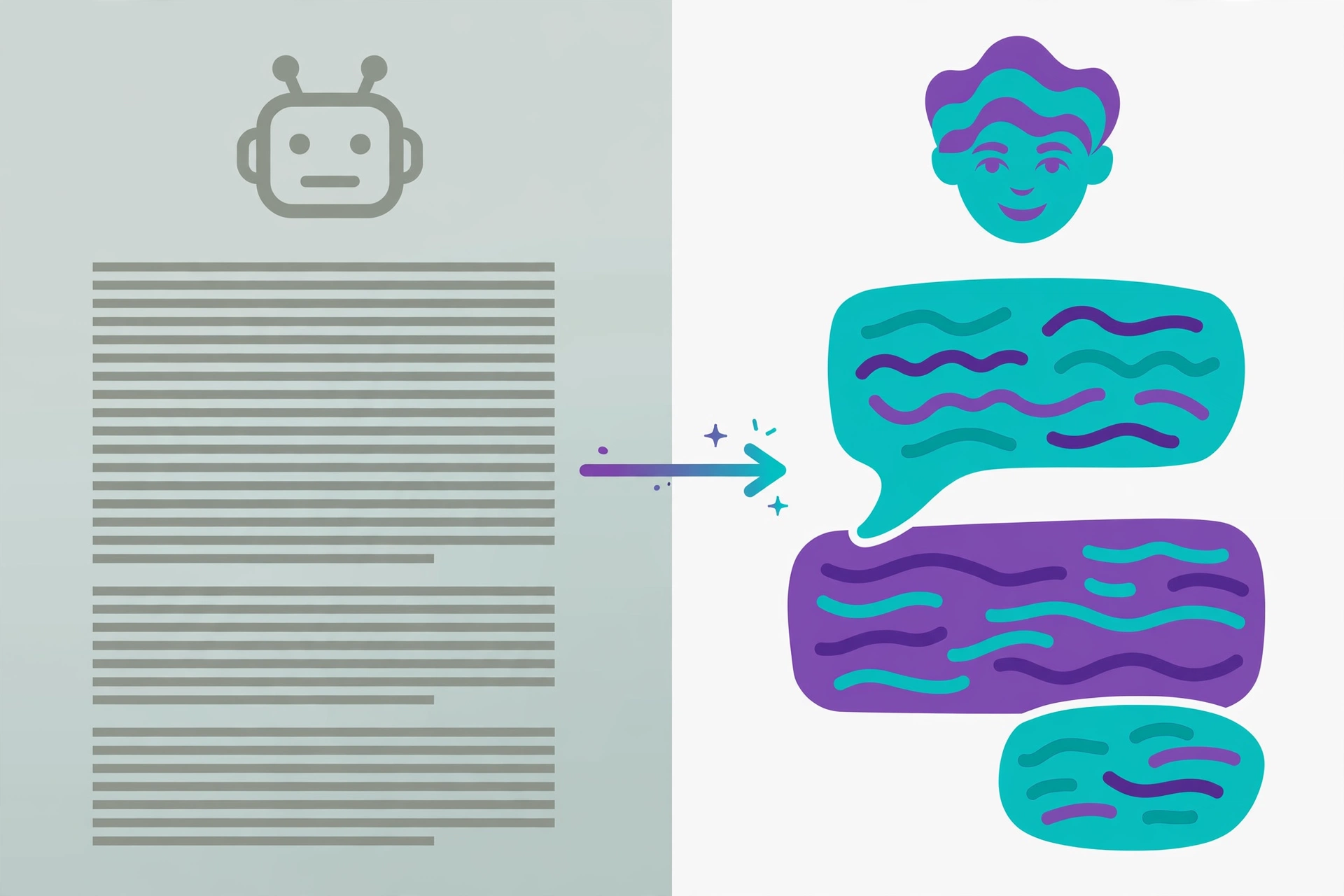
To humanize AI content is to edit an AI-generated draft so it carries the marks of a real author: a recognizable voice, real experience, specific details, and judgment. It is not about tricking AI detectors (we will explain why that is a losing game). It is about making the article genuinely better for the human reading it.
Think of it this way: the AI gives you clay. Humanizing is the sculpting. A detector might struggle to tell good clay from a finished sculpture — but your reader never does. And Google’s helpful content guidance rewards exactly what humanizing adds: original insight, first-hand experience, and content written for people first.
Does Google Penalize AI Content in 2026?
Short answer: no — not for being AI-generated. Google’s position has been consistent: what matters is content quality, not how the content was produced. Appropriate use of AI is not against their guidelines; their ranking systems reward high-quality, helpful content however it is created.
What Google does penalize is scaled content abuse — mass-producing thin, unhelpful pages mainly to manipulate rankings. That practice was added to Google’s spam policies in March 2024, and it applies whether a human or a machine wrote the pages.
Two more 2026 realities worth knowing:
- Google can identify AI-generated content. Its SynthID watermarking now spans text, images, audio, and video, with a public detector released in 2025. But Google uses that signal for quality assessment — not automatic penalties.
- AI detectors are probability engines, not lie detectors. Tools like GPTZero and Originality.ai measure perplexity (how predictable word choices are) and burstiness (how much sentence length varies). They flag raw AI output reliably — but they also flag human writing that is too formal or repetitive. Chasing a 0% AI score is a treadmill: the moment you optimize for the detector instead of the reader, you have lost the plot.
Bottom line: humanize for your reader and for E-E-A-T, not for a detector score.
5 Fingerprints That Make AI Content Sound Robotic
Before the techniques, learn to spot the tells. Run every AI draft through this five-point scan first:
- The “landscape” opener. “In today’s rapidly evolving digital landscape…” If your intro could open an article about literally anything, delete it and start with something real.
- Uniform sentence length. AI writes in medium-length sentences, one after another, like a metronome. Humans mix short punches with longer, winding explanations.
- Hedge stacking. “It is important to note that…” “It is worth mentioning…” “In conclusion…” — throat-clearing phrases that say nothing. Real writers just say the thing.
- Generic examples. “For example, a business might use this strategy to improve results.” Which business? What results? AI speaks in abstractions because it has no memories.
- No stakes, no opinions. AI never disagrees with anything. It presents every side equally and concludes nothing. Humans take positions — and readers trust writers who do.
How to Humanize AI Content: 9 Proven Techniques
Here are the nine techniques, in the order that gives you the most leverage for the least effort.
1. Fix the prompt before you fix the draft
Most guides on how to humanize AI content start at the editing stage. That is backwards. A better prompt produces a draft that needs half the editing.
Instead of: “Write a blog post about email marketing.”
Try: “Write a first draft about email marketing for small business owners. Use a direct, slightly informal tone. Include one contrarian opinion. Do NOT use phrases like ‘in today’s digital landscape,’ ‘delve,’ or ‘game-changer.’ Leave [EXAMPLE NEEDED] placeholders wherever a real example would help.”
Three prompt upgrades that matter most:
- Feed it your voice. Paste two or three paragraphs of your own best writing and say “match this tone.” This single step does more than any humanizer tool.
- Demand roughness. Ask for a “messy first draft.” Polished AI output is harder to humanize because every sentence sounds finished — you become less likely to rewrite it.
- Ban the tells. Give the AI a short blacklist of phrases you never want to see. You will still edit, but you will start much closer to the finish line.
A strong content brief does the same job at team scale — our guide to SEO content briefs writers actually follow shows how to systematize this so every writer (human or AI-assisted) starts from the same voice.
2. Delete the AI tell phrases
Keep a running list of phrases AI overuses and search for every one in each draft: “In today’s fast-paced world,” “It is important to note,” “When it comes to,” “In conclusion,” “delve,” “tapestry,” “landscape” (as a metaphor), “game-changer,” “unlock,” “elevate.” Delete them outright — do not replace them with synonyms. Most of these sentences work better with the phrase simply gone.
3. Add information gain only you have
This is the single biggest lever, and the one most competing guides skip. Google’s quality systems look for information gain — value a reader cannot get from the other nine results on the page. AI cannot produce:
- Something you tested and measured (“We tried this on three landing pages; conversions rose 18%.”)
- A screenshot, a photo, a real document from your work
- An opinion that risks being wrong (“Most keyword tools overcomplicate this. Here is the only metric I check.”)
- A story about failing (“The first version of this flopped because we published daily and burned out.”)
One genuine paragraph of first-hand experience outweighs ten paragraphs of polished generic advice — for readers, for E-E-A-T, and for rankings.
4. Vary rhythm on purpose
Read any paragraph and check: are all the sentences roughly the same length? Break the metronome. Follow a long, explanatory sentence with a short one. For punch. Use fragments occasionally — sparingly, for emphasis. Split a dense paragraph in two. Combine two choppy ones. Rhythm is the fastest way to make text feel spoken rather than generated, and it is the thing detectors measure as “burstiness” — which is why it works on both audiences.
5. Write like you speak (but edit like a pro)
Use contractions (don’t, can’t, here’s). Ask the reader direct questions. Use “you” more than “one” or “users.” None of this means being sloppy — it means being natural. The test the best editors use: read the sentence and ask, “Would I say this to a colleague over coffee?” If not, rewrite it until you would.
6. Replace generic examples with specific ones
AI version: “Businesses can benefit from using social media to reach customers.”
Human version: “A 12-person accounting firm in Austin got 40% of its new clients from LinkedIn posts the founder wrote on Sunday nights.”
Specifics — numbers, names, places, timeframes — are the cheapest credibility you can buy. When you cannot use a real example, say so and use a clearly labeled hypothetical instead of a vague abstraction. Readers forgive “imagine” far faster than they forgive vagueness.
7. Add friction: disagree with something
AI loves consensus; humans argue. Find one piece of common advice in your niche and push back on it — honestly, with reasoning. “Everyone says publish daily. For most blogs, that is how you burn out and publish filler. Twice a week, done well, beats daily noise.” A single sharp disagreement does more for perceived authorship than any humanizer tool, because it is something a prediction engine is structurally reluctant to do.
8. Fact-check like an editor, not a fan
AI hallucinates confidently: fake statistics, outdated features, wrong dates, invented quotes. Before publishing, verify every number, name, price, and product claim against a primary source. This is also where you add the citations and outbound links that E-E-A-T demands. A natural-sounding sentence can still be wrong — and wrongness destroys trust faster than robotic tone ever could.
9. Read it aloud — once, as a reader
Final pass: stop hunting for “AI writing” and just read the piece normally, out loud if you can. Awkward rhythm, repeated words, and stiff transitions jump out the moment you hear them. Fix what snags, then stop. Over-editing is its own disease — which brings us to the mistakes.
The 30-Minute Humanize Pass: A Repeatable Workflow
Techniques are useless without a process. Here is the exact pass that shows how to humanize AI content on a typical 1,500-word AI draft:
- Minutes 0–5: Structure scan. Read the headings only. Does the argument flow? Cut or merge any section that repeats another. Move the most useful section higher — readers should hit value fast.
- Minutes 5–15: Voice pass. Search your AI-tell blacklist. Vary sentence rhythm. Add contractions and direct address. This is pure line editing — no new research, no new ideas.
- Minutes 15–25: Evidence pass. Add one real example, number, or story per major section. Drop in [EXAMPLE NEEDED] placeholders anywhere you cannot add one right now — and fill at least half of them before publishing.
- Minutes 25–30: Read-aloud. One pass, out loud, as a reader — not an editor. Fix the snags. Publish.
Thirty minutes turns a 6/10 draft into a 9/10 article. An hour is even better. The point is that humanizing is a bounded task with a finish line — not an endless rewrite that eats your week.

5 Humanizing Mistakes That Make Things Worse
- Chasing a 0% detector score. Diminishing returns kick in fast, and content optimized for detectors usually reads worse for humans. Aim for “sounds like me,” not “fools the tool.”
- Synonym-spam. Swapping words without changing structure (“utilize” becomes “leverage”) keeps the robotic skeleton intact and can quietly distort meaning. Rewrite sentences, not words.
- Purple-prose overcorrection. Adding flowery language to sound human just sounds like a different kind of fake. Natural beats literary every time.
- Using a humanizer tool as the final step. Tools are a starting aid, not a finish line. Every tool output needs your eyes — for meaning, accuracy, and voice.
- Stripping out all imperfection. One slightly informal aside or short fragment adds humanity. Sterile perfection is itself an AI tell.
Before and After: A Real Rewrite Example
AI draft:
“In today’s competitive digital landscape, it is important to note that businesses should leverage social media platforms to enhance their online visibility and engage with their target audience effectively.”
Humanized:
“Your customers are on social media. The question is whether your posts give them a reason to stop scrolling. Post one useful thing per day — a tip, a result, a mistake you made — and see what happens over 90 days.”
Same information. One sounds like a brochure; the other sounds like advice from someone who has done it. That gap — specificity, directness, a point of view — is the entire game when you humanize AI content.
Frequently Asked Questions
How do you humanize AI content quickly?
Use the 30-minute pass above: 5 minutes on structure, 10 on voice, 10 on adding real examples, and 5 reading aloud. For longer pieces, a humanizer tool can speed up the voice pass — but always finish with your own read-through.
Can Google detect AI content?
Yes. Google’s SynthID watermarking can identify AI-generated text, and third-party detectors measure statistical patterns like perplexity and burstiness. But Google has stated it does not penalize content for being AI-generated — it penalizes thin, unhelpful content regardless of who or what wrote it.
Will humanized AI content rank on Google?
Yes, if it is genuinely helpful. Rankings come from satisfying search intent, demonstrating E-E-A-T, and earning engagement — all of which humanizing directly improves. Raw, unedited AI drafts usually fail on all three, which is why they underperform.
What is the best AI humanizer tool?
No single tool wins for everyone. Look for tools that restructure sentences rather than just swapping synonyms, that preserve meaning, and that let you control tone. Treat any tool as a first-pass assistant: final quality always comes from human editing.
Should I disclose that AI helped write my content?
Google does not require disclosure for ranking purposes. For marketing and business content, it is a brand decision. For journalism, academia, or anything where readers reasonably expect human authorship, disclose it — trust is much harder to rebuild than rankings.
Conclusion
Learning how to humanize AI content comes down to one shift: stop asking “does this pass as human?” and start asking “is this genuinely useful, and does it sound like me?” Fix your prompts before you fix your drafts. Delete the tells. Add what only you know. Vary the rhythm. Give every draft a focused 30-minute pass. Do that consistently, and mastering how to humanize AI content means your AI-assisted content will not just avoid sounding robotic — it will outperform the generic, untouched drafts your competitors keep publishing.