If you own a business that serves customers in a certain city or area, people need to be able to find you online. This is where local SEO can help.
But what is local SEO, and how does it work?
Local SEO is the process of improving your online presence so your business can appear for searches related to a specific location. It is useful for restaurants, dentists, plumbers, shops, agencies, salons, repair services, and many other local businesses.
For example, someone may search for “dentist near me” or “plumber in Karachi.” These searches show local intent because the person wants a nearby business.
A good local SEO strategy can help more people discover your business through Google Search, Google Maps, and other local platforms.
This guide explains how local search engine optimization works and what you can do to improve your local visibility.
What Is Local SEO?
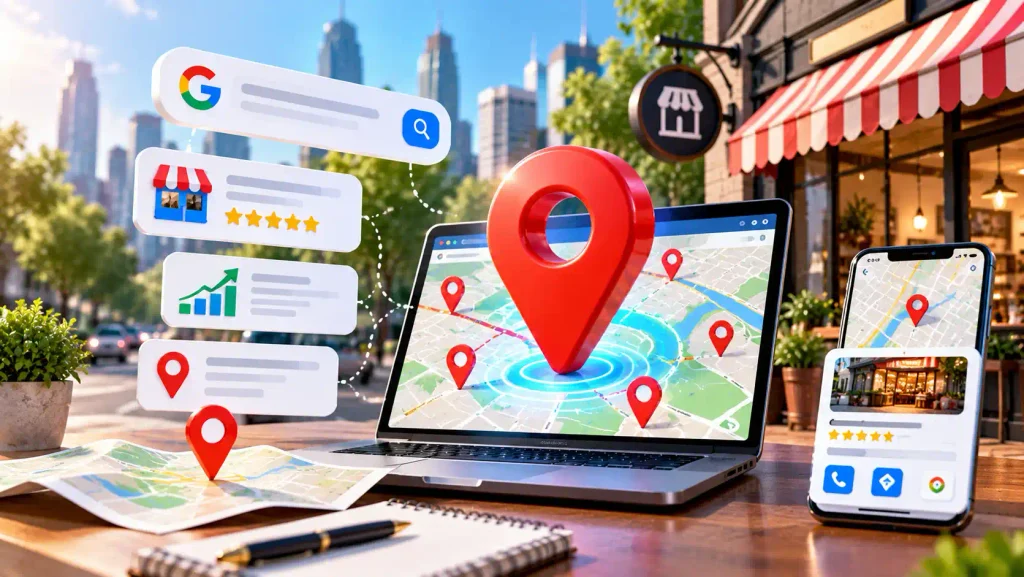
Local SEO is the process of improving a business’s online presence for location-based searches.
It helps search engines understand:
- What your business does
- Where your business is located
- Which areas you serve
- How customers can contact you
- When your business is open
- How relevant your business is to a local search
For example, imagine you own a bakery in Lahore.
Someone searches:
“bakery near me”
Google may show bakeries close to that person’s location.
Local SEO can help make your business information clear and useful so search engines and potential customers can understand your business.
Why Is Local SEO Important?
Why is local SEO important for businesses?
People often use search engines when they are ready to find a nearby product or service.
They may search for:
- Restaurant near me
- Dentist in Lahore
- Plumber in Karachi
- Car repair shop near me
- SEO agency in Islamabad
- Coffee shop nearby
A strong local presence can help a business:
- Reach nearby customers
- Get more website visits
- Receive more phone calls
- Increase store visits
- Improve local brand awareness
- Appear in localized search results
- Make important business information easier to find
This is especially useful for companies with physical locations or defined service areas.
How Does Local SEO Work?
So, how does local SEO work?
When someone performs a local search, search engines try to provide businesses that match the person’s needs and location.
Google explains local results mainly around relevance, distance, and prominence.
In simple terms, search engines want to understand what your business offers, where it is located, and how well known it is.
Your website is only one part of this process.
Search engines may also use information from:
- Your Google Business Profile
- Business listings
- Customer reviews
- Local citations
- Your website
- Links
- Local content
- Other online sources
All these signals can help create a clearer picture of your business.
What Is Local Intent?
Local intent means that a searcher wants information, a product, or a service connected to a certain area.
Some searches clearly include a location.
For example:
“dentist in Islamabad”
Other searches may not include a city name.
For example:
“dentist near me”
Search engines can use location information and other signals to provide useful local results.
Understanding local intent is important when creating your pages and choosing keywords.
What Is a Google Business Profile?
Google Business Profile is an important tool for many local businesses.
It allows a business owner to provide useful details about the company.
These details can include:
- Business name
- Address and phone number
- Website
- Business category
- Opening hours
- Services
- Photos
- Customer reviews
- Other relevant details
Keep your business information correct and up to date.
If you change your phone number or opening hours, update your profile.
Accurate information makes it easier for customers to contact or visit you.
How to Optimize Your Google Business Profile
Creating a profile is only the beginning.
Make sure your profile is complete.
Start with your real business name. Choose the category that best describes what you do.
Add accurate contact details and opening hours.
You should also:
- Add useful photos
- List your services
- Keep your details updated
- Respond to reviews
- Add relevant information
- Check your profile regularly
Do not fill your business name or description with unnecessary keywords.
Your profile should be made for real customers.
What Is the Google Local Pack?
The local pack is a local search feature that can show businesses for location-based searches.
It may appear with map information and business details.
For example, if someone searches for a nearby restaurant, Google may show a group of relevant businesses along with Google Maps information.
The exact appearance of local results can change.
Your website’s normal organic results and local search features are not exactly the same.
A business can therefore work on both traditional organic SEO and local SEO.
What Are Local Keywords?
Local keywords are search terms connected to a geographic area.
Examples include:
- Dentist in Lahore
- Plumber in Karachi
- SEO company in Islamabad
- Bakery near me
- London removal company
- Car repair in Manchester
Local keyword research can help you understand how customers search.
Start with the services you provide.
Then consider the areas you serve.
For example, a plumber in Karachi might create useful content about plumbing services in Karachi rather than repeatedly adding the city name to every sentence.
Keep your writing natural.
How to Use Local Keywords
Use local keywords where they make sense.
They may appear in:
- Page titles
- Main headings
- Service pages
- Location pages
- Meta descriptions
- Website content
- Image information
- Internal links
Do not stuff keywords into your content.
For example, repeating “best plumber in Karachi” twenty times does not make a page more useful.
Write for people first.
Your page should clearly explain what you provide and where you provide it.
What Are Local Citations?
Local citations are online mentions of your business.
They often include information such as
- Business name
- Address
- Phone number
You may also hear these details called NAP information: name, address, and phone number.
Local citations may appear on:
- Business directories
- Industry websites
- Local websites
- Review platforms
- Chamber of commerce websites
- Local publications
The main goal is accuracy.
If one listing shows an old phone number and another shows your current number, customers may become confused.
Keep important details consistent.
Why Are Business Listings Important?
Business listings help customers find basic information about your company.
A listing may contain your name, location, contact details, website, opening hours, and services.
Do not create listings on every directory you can find.
Focus on useful and relevant platforms.
For example, an industry-specific directory may make sense for your company.
A respected local directory may also help customers discover you.
Check existing listings as well. Old listings may contain outdated information.
Why Do Customer Reviews Matter?
Reviews can help people decide whether they want to contact a business.
Imagine two nearby restaurants.
One has many detailed reviews from real customers. The other has almost no information from customers.
People may use those reviews when deciding where to eat.
Businesses can encourage customers to leave reviews, but those reviews should be genuine.
Do not buy fake reviews.
You should also respond to reviews when appropriate.
A polite response can show that you care about customer feedback.
How to Ask Customers to Leave Reviews
Make the process easy.
You can ask satisfied customers to share their experience after using your service.
For example, you can provide a direct review link in a follow-up message or email.
Do not pressure people into leaving only positive reviews.
The goal is genuine feedback.
You should also avoid offering misleading rewards for positive reviews.
A natural review profile is more useful for customers.
What Is Local Link Building?
Local link building focuses on earning relevant links from websites connected to your location or industry.
Possible sources include:
- Local newspapers
- Local blogs
- Business organizations
- Community websites
- Industry publications
- Local event websites
- Relevant directories
Imagine your business supports a community event.
The event’s website may mention your company and link to your site.
That link makes sense because there is a genuine relationship.
This is usually better than collecting random links from unrelated websites.
What Are Location Pages?
A location page is a webpage created for a specific area that a business serves.
For example, a company serving three cities might have:
- Services in Karachi
- Services in Lahore
- Services in Islamabad
Each page should contain useful information about that location.
Do not simply copy one page and change the city name.
Instead, you can include:
- Services available in that area
- Useful local information
- Contact options
- Opening hours where relevant
- Service-area details
- Location-specific FAQs
Unique pages provide more value to visitors.
Local SEO for Businesses With Physical Locations
Local SEO is very useful for businesses with physical locations.
Examples include:
- Restaurants
- Dental clinics
- Shops
- Gyms
- Salons
- Hotels
- Repair centers
- Medical clinics
Make sure customers can easily find your location.
Your website should clearly display useful contact information.
If customers visit your business, accurate directions, hours, and location details are important.
Your Google Business Profile should also match your real-world business details.
Local SEO for Service-Area Businesses
Not every local company has a storefront that customers visit.
Some businesses travel to their customers.
Examples include:
- Plumbers
- Electricians
- Cleaners
- Mobile repair services
- Pest control companies
- Home maintenance services
- Removal companies
These companies can still use local SEO.
Clearly explain the areas you serve.
Create useful service pages and location information where appropriate.
Do not pretend to have physical locations in places where you do not actually operate.
Local SEO vs. Traditional SEO
Traditional SEO and local SEO share many ideas, but local SEO has a stronger location focus.
Consider these two searches:
Traditional search:
“How to repair a leaking pipe”
Local search:
“Plumber near me”
The first person wants information.
The second person is probably looking for a nearby service.
Traditional SEO can help a website appear in regular organic results.
Local SEO focuses more on searches where location matters.
A local business can use both strategies.
How Can a Business Improve Its Local Rank?
There is no single trick that guarantees a better local rank.
Instead, focus on building a complete and accurate online presence.
You can:
- Complete your Google Business Profile
- Keep business details accurate
- Create useful local content
- Target relevant local keywords
- Earn genuine reviews
- Build useful local citations
- Improve your website
- Earn relevant links
- Create strong location pages
- Keep opening hours updated
Do not focus only on one factor.
Local visibility is built through several connected signals.
How Search Engines Choose Local Results
When someone makes a local search, Google can consider relevance, distance, and prominence.
Relevance is about how closely a business matches what the person is searching for.
Distance relates to how far a business is from the location used in the search.
Prominence relates to how well known a business may be.
This helps explain why the closest company does not always appear first.
How a business ranks can depend on several signals rather than distance alone.
Keep Your Business Information Accurate
Accurate business information is one of the simplest parts of local SEO.
Check your:
- Business name
- Address and phone number
- Website URL
- Opening hours
- Categories
- Service information
- Location details
Update this information when something changes.
This is especially important during holidays or special opening hours.
Incorrect details can create a poor experience.
A customer who travels to a closed shop because the hours were wrong may lose trust in the business.
How to Do Local SEO for Beginners
Beginners can start with a simple process.
Step 1: Check Your Website
Make sure your website works well on desktop and mobile devices.
Your services and contact details should be easy to find.
Step 2: Set Up Your Google Business Profile
Add complete and accurate information.
Choose suitable categories and include your real contact details.
Step 3: Research Local Keywords
Find terms people use when searching for your services in your area.
Focus on relevant terms rather than creating huge keyword lists.
Step 4: Improve Your Service Pages
Clearly explain each service.
Include location information naturally where it helps users.
Step 5: Check Business Listings
Find important listings and correct outdated information.
Step 6: Build Local Citations
Create accurate citations on useful local and industry platforms.
Step 7: Get Genuine Reviews
Ask real customers for honest feedback.
Respond professionally when appropriate.
Step 8: Create Local Content
Publish content that answers questions from people in your target area.
Step 9: Earn Relevant Links
Look for genuine opportunities with local publications, organizations, and industry websites.
Step 10: Monitor Your Progress
Review search visibility, calls, website visits, and other useful results.
This gives you a basic local SEO strategy that you can improve over time.
Common Local SEO Mistakes
Local SEO does not need to be complicated, but some mistakes can reduce its effectiveness.
Avoid:
- Using incorrect contact details
- Creating duplicate listings
- Ignoring customer reviews
- Buying fake reviews
- Choosing unrelated categories
- Stuffing local keywords
- Creating thin location pages
- Using fake addresses
- Ignoring mobile users
- Leaving old opening hours online
- Building irrelevant links
Good local SEO is mainly about providing accurate and useful information.
Frequently Asked Questions About Local SEO
How to Do Local SEO for Beginners?
Start with your website and Google Business Profile. Make sure your contact details are correct. Research local keywords, improve your service pages, build useful local citations, collect genuine reviews, and create helpful location-based content.
Can I Do Local SEO Myself?
Yes. A business owner can handle many basic local SEO tasks. You can update business information, manage your Google Business Profile, respond to reviews, research local keywords, and improve your website yourself.
More complex websites or highly competitive markets may require professional help.
Is Doing Local SEO Worth It?
Local SEO can be useful for businesses that depend on customers in specific geographic areas.
It can help people discover your business when they search for nearby products or services. The value will depend on your business, market, competition, and customers.
Is Local SEO Free?
Many basic local SEO tasks can be done without paying for SEO software.
For example, creating useful website content and managing eligible business information on major platforms may not require paid SEO tools.
However, a business may still spend money on its website, content creation, SEO tools, advertising, or professional services.
How Long Does Local SEO Take?
There is no fixed time.
Results can depend on your competition, location, website, current visibility, business history, and the quality of your work.
Some changes may be noticed quickly, while building a strong local presence can take much longer.
Do Reviews Help Local SEO?
Reviews are useful for local businesses because they provide information about customer experiences. They can also contribute to a business’s overall local presence.
Focus on getting honest reviews from real customers.
Does Every Business Need Local SEO?
No.
Local SEO is most relevant when location matters to customers.
A restaurant, dentist, plumber, or local shop may benefit greatly from it. A website serving a worldwide audience with no geographic focus may have less need for a local strategy.
Final Thoughts
So, what is local SEO?
Local SEO is the process of improving a business’s visibility for searches connected to a location.
It can help local businesses reach nearby customers through search engines, Google Maps, the local pack, business listings, and regular organic results.
A good local SEO strategy starts with accurate information.
Keep your business name, address and phone number, website, hours, and services updated. Use relevant local keywords. Build useful local citations. Create quality location pages and encourage real customers to leave reviews.
You should also create helpful content and build genuine connections with local websites and organizations.
There is no single action that makes local SEO work.
Instead, focus on creating a trustworthy online presence that clearly tells customers what your business does, where it operates, and how they can reach you.
When your website, business profiles, reviews, citations, and local content work together, you create a stronger foundation for long-term visibility in localized search results.