Link building is an important part of SEO. It can help search engines understand how websites and pages are connected. It can also help people discover useful content on other websites.
There are many ways to build links. Two common methods are guest posting and link insertion.
These methods may look similar because both can place a backlink on another website. However, they work in different ways.
With guest posting, you create a new article for another website. With link insertion, a link is added to an existing article.
This guide explains guest posting vs. link insertion in simple terms. You will learn how each method works, their main differences, benefits, costs, risks, and how to choose the right option for your SEO strategy.
What Is Guest Posting?
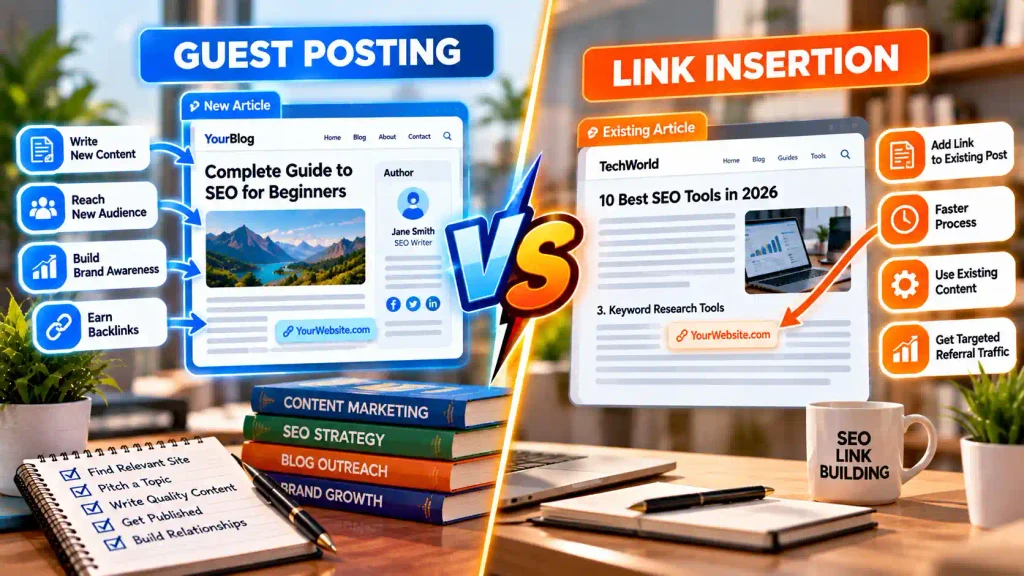
Guest posting means writing a new article for another website.
It is also known as guest blogging.
For example, imagine you own an SEO agency. You find a marketing website that accepts guest articles. You suggest a topic about keyword research.
The website approves your idea. You then write the article and send it to the editor.
If the article meets the site’s rules, the publisher posts it on the website.
The article may also include a relevant link to your website. This depends on the publisher’s rules.
Guest posting can help you:
- Build brand awareness
- Reach a new audience
- Generate referral traffic
- Share your knowledge
- Build relationships
- Publish useful content
- Earn relevant backlinks
- Grow your online presence
The key point is simple: guest posting requires new content.
You are not just asking for a link. You are giving the publisher a complete article that should be useful to its readers.
How Does Guest Posting Work?
Guest posting usually involves several steps.
1. Find Relevant Websites
Start by finding websites related to your industry.
If your business is about SEO, look for marketing, business, technology, or SEO websites.
Relevance is important. A link from an unrelated website may provide little value to readers.
2. Check the Website
Do not contact every website you find.
First, check its content.
Look at:
- Topics
- Recent posts
- Content quality
- Audience
- Organic traffic
- Website history
- Editorial standards
You should also check whether the site accepts guest posts.
3. Read the Guidelines
Some websites have a “Write for Us” or contributor page.
Read the rules before contacting the publisher.
The guidelines may explain:
- Accepted topics
- Word count
- Link rules
- Images
- Writing style
- Author bio
- Formatting
Following these rules can improve your chances of getting accepted.
4. Send Your Pitch
Next, contact the website owner or editor.
Keep your email short.
Introduce yourself and suggest a few useful topics. Your ideas should match the site’s audience.
Avoid sending the same message to hundreds of websites.
5. Write the Article
If your topic is approved, write the article.
Create original and useful content. Use short paragraphs and clear headings.
Do not make the whole article about your company.
A good guest post should help readers even if they never click your backlink.
6. Submit the Article
Send your finished article to the publisher.
The editor may request changes. Make those changes if they are reasonable and match the site’s guidelines.
7. Get Published
Once approved, the article goes live.
You can then share the post through your website, email list, or social media.
What Is Link Insertion?
A link insertion is different.
Instead of creating a new article, a link is placed inside an article that already exists.
It may also be called:
- Niche edit
- Contextual link
- Link addition
- Existing-content placement
- Contextual link placement
For example, imagine a website already has an article called:
“10 Ways to Improve Your Website SEO”
One section discusses keyword research.
You have a detailed guide about keyword research on your website.
If your guide provides useful extra information, the publisher could add a link to it inside that existing section.
No completely new article is needed.
That is a link insertion.
How Does Link Insertion Work?
Link insertion usually has a shorter process than guest posting.
1. Find a Relevant Website
Start with websites related to your topic.
Do not focus only on SEO metrics.
Look for a real website with useful content and a relevant audience.
2. Find an Existing Article
Next, find an article where your resource would make sense.
The page should be closely connected to your content.
For example, if your page is about technical SEO, you could look for existing articles about:
- SEO audits
- Website optimization
- Crawling
- Indexing
- Website speed
- Technical SEO
3. Check the Context
Do not choose a page simply because it can contain your keyword.
Read the article.
Ask yourself:
Would my link actually help someone reading this section?
If the answer is yes, the placement may make sense.
4. Contact the Publisher
Contact the website owner, editor, or content manager.
Explain which article you found and which resource you think could be useful.
Be clear about where the link could fit.
5. Publisher Reviews the Link
The publisher decides whether your resource adds value.
If accepted, the editor may update a sentence or paragraph and add your link.
The original article remains mostly unchanged.
Guest Posting vs. Link Insertion: Main Difference
The biggest difference is new content vs. existing content.
Guest posting: You create a new article.
Link insertion: Your link is added to an article that already exists.
Here is a simple comparison:
FeatureGuest PostingLink InsertionNew articleYesUsually noUses existing articleNoYesWriting requiredYesUsually lessOutreachUsuallyUsuallyBacklink opportunityPossiblePossibleReferral trafficPossiblePossibleBrand exposureHigher potentialUsually lowerPublishing timeOften longerCan be fasterContent controlMoreLessMain purposeNew content contributionRelevant contextual reference
Neither option is automatically better.
The right method depends on your website, goals, budget, audience, and SEO strategy.
Benefits of Guest Posting
Guest posting offers more than a backlink.
More Brand Exposure
A full article gives you more space to share useful ideas.
Readers may remember your name or brand after reading the article.
Reach New Audiences
You can publish on websites that already have readers in your target market.
This can introduce your business to people who have never visited your site.
Referral Traffic
Readers may click a useful link in your guest post.
These visitors are called referral traffic.
Build Relationships
Guest posting often involves direct contact with editors and website owners.
A successful article can lead to future opportunities.
Show Your Knowledge
A detailed article gives you a chance to show your experience in a topic.
This can be useful for businesses, agencies, consultants, and professionals.
Benefits of Link Insertion
Link insertion has different benefits.
Less Content Creation
You normally do not need to write a full article.
This can save time.
Existing Content
The article is already published.
In some cases, it may already have search visibility, backlinks, readers, or a history in search engines.
However, this should always be checked rather than assumed.
Strong Context
A link can be placed in a section that directly relates to your resource.
This can make it useful for readers.
Faster Process
Because a completely new article does not need to be written and published, the process can sometimes be faster.
The actual timeline still depends on the publisher.
Which Is Better for SEO?
There is no single answer.
A guest post on a strong and relevant website may be useful.
A contextual link inside a highly relevant existing article may also be useful.
The method itself does not determine quality.
Instead, consider:
- Website relevance
- Page relevance
- Content quality
- Link context
- Website reputation
- Editorial standards
- Organic visibility
- Anchor text
- Referral traffic
- Audience quality
- Overall backlink profile
A poor-quality guest post is not automatically better than a good link insertion.
Likewise, a link insertion on an unrelated page is not automatically valuable because the page already exists.
Quality and relevance matter more than the name of the method.
Website Relevance Matters
Relevance should be one of your first checks.
Suppose your website sells accounting software.
A link from an article about small-business finance could make sense.
A link from an unrelated article about pets may not.
The same idea applies to guest posts.
Choose websites where your business, content, and target audience naturally fit.
This makes the placement more useful for readers.
Page Relevance Matters Too
Website relevance is not enough.
The specific page should also be relevant.
Imagine you want a backlink to your guide about email marketing.
A marketing website may have hundreds of articles.
A link from its email marketing guide would have a clear connection.
A link from an unrelated office furniture article would not.
Always check both the domain and the page.
Content Quality
Content quality matters in both methods.
For guest posting, your new article should be useful, original, and easy to read.
For link insertion, the existing article should already offer useful information.
Avoid pages that are:
- Very thin
- Poorly written
- Full of random links
- Outdated
- Unrelated to the topic
- Made only for link placements
A backlink should sit inside content that has a clear purpose for readers.
Anchor Text in Guest Posts and Link Insertions
Anchor text is the clickable text of a link.
For example:
“Read our technical SEO guide for more information.”
Here, “technical SEO guide” is the anchor text.
Anchor text can be:
- Branded
- Descriptive
- Partial-match
- Generic
- Natural
- Exact-match
The anchor should fit the sentence.
Do not force keywords into places where they sound strange.
Also avoid using the exact same commercial anchor across many websites.
A natural backlink profile usually contains different types of anchor text.
Referral Traffic
Backlinks are not useful only because of SEO.
They can also send real visitors to your website.
This is called referral traffic.
Guest posts can generate referral traffic because readers discover your brand through a full article.
Link insertions can also send traffic when the link helps readers find more information about the topic.
Traffic depends on many factors, including:
- Page popularity
- Search visibility
- Audience size
- Link position
- Topic
- Link relevance
- Anchor text
- Reader interest
A relevant link on a useful page can sometimes be more valuable than many links that nobody clicks.
Brand Awareness
Guest posting usually offers more opportunities for brand awareness.
Why?
Because you have an entire article to communicate your knowledge.
Some publishers may also include your author name, company, or bio.
With link insertion, the reader may only see a contextual link.
This means link insertion can be useful for connecting readers to a resource, but it may provide less direct brand exposure.
If brand awareness is an important goal, this difference is worth considering.
Guest Posting vs. Link Insertion for New Websites
New websites often need both content and visibility.
Guest posting can introduce a new business to relevant audiences.
It can also help the owner build relationships with other publishers.
Link insertion may be useful when the new website already has a strong resource worth referencing.
For example, you may have:
- An original study
- A detailed guide
- A useful tool
- Statistics
- Research
- A calculator
- A free template
These assets can give publishers a real reason to reference your page.
How Long Does Each Method Take?
Guest posting normally involves more steps.
You need to:
Find a website → pitch a topic → get approval → write the article → edit it → submit it → wait for publication.
Link insertion can involve fewer steps:
Find a website → find a relevant page → suggest the resource → get approval → link is added.
For this reason, link insertion may sometimes be faster.
However, every publisher has a different process.
Some guest posts can be published quickly, while some link insertion requests may take weeks.
Cost Differences
There is no fixed price for either method.
Costs can depend on:
- Website quality
- Traffic
- Niche
- Content requirements
- Writer fees
- Publisher policies
- Outreach work
- Editing
- Geographic market
Guest posting may require more work because a complete article must be created.
Link insertion may require less writing, but that does not mean it is always cheaper.
Compare the overall value rather than choosing an option only because of price.
How to Evaluate a Guest Post Opportunity
Before publishing a guest post, ask:
- Is the website relevant?
- Does it publish useful articles?
- Does it have a real audience?
- Are recent posts good quality?
- Does my topic fit?
- Are links used naturally?
- Does the website have clear editorial standards?
- Could readers find my article useful?
Do not rely on one SEO metric.
Metrics can help with research, but they do not tell the whole story.
How to Evaluate a Link Insertion Opportunity
For link insertion, check both the website and the exact page.
Ask:
- Is the page relevant?
- Is the article useful?
- Is it indexed?
- Does the content still look current?
- Would my resource add useful information?
- Is the surrounding text relevant?
- Are there too many external links?
- Does the anchor text sound natural?
- Could real readers click the link?
If the link feels forced, the placement may not be a good choice.
Can You Use Both Methods?
Yes.
Guest posting and link insertion do not have to compete with each other.
A wider content marketing strategy can use different methods when they make sense.
For example, you could use guest posting when you have a strong article idea for a publisher.
You could use link insertion when you have a useful resource that naturally supports an existing article.
The important point is not to use one method everywhere.
Choose the method that fits the content and audience.
Common Guest Posting Mistakes
Guest posting can lose value when quality is ignored.
Common mistakes include:
- Publishing on unrelated sites
- Writing thin articles
- Using the same article on many sites
- Adding too many promotional links
- Ignoring editorial guidelines
- Overusing exact-match anchor text
- Focusing only on domain metrics
- Writing only for search engines
Your article should be useful even without the backlink.
Common Link Insertion Mistakes
Link insertion also has common problems.
Avoid:
- Adding links to unrelated pages
- Forcing links into old content
- Choosing pages only because they have high metrics
- Using unnatural anchor text
- Linking to weak resources
- Ignoring the surrounding paragraph
- Adding links where readers do not need them
- Focusing only on backlink numbers
The link should improve the reader’s experience.
If removing the link makes no difference to the reader, ask whether the placement really adds value.
Guest Posting vs. Link Insertion: Which Should You Choose?
Start with your goal.
If you want to publish a complete article, reach a new audience, demonstrate expertise, and increase brand exposure, guest posting may fit that goal.
If you already have a strong resource and find a relevant existing article where that resource adds useful information, link insertion may fit better.
You can also use both.
Do not choose based only on which option gives you a backlink faster.
Think about relevance, content quality, readers, context, and long-term value.
Frequently Asked Questions
Is Guest Posting the Same as Link Insertion?
No. Guest posting requires creating a new article for another website. Link insertion usually means adding a relevant link to an article that is already published.
Which Is Faster, Guest Posting or Link Insertion?
Link insertion can sometimes be faster because you do not need to create a full new article. However, the actual time depends on the website owner and editorial process.
Can Both Methods Generate Backlinks?
Yes. Both methods can result in backlinks when the publisher allows them. The value depends on the website, page, context, relevance, and link attributes.
Are Guest Posts Good for SEO?
Guest posts can support brand awareness, referral traffic, content marketing, and publisher relationships. They may also contain relevant links. Their SEO value depends on the quality and context of each placement.
Are Link Insertions Good for SEO?
A contextual link inside useful and relevant content can connect readers with additional information. Its SEO value depends on factors such as page relevance, website quality, link context, and how the link was obtained.
Is Link Insertion the Same as a Niche Edit?
The terms are often used in similar ways. A niche edit generally means adding a contextual link to existing content. However, different publishers or SEO providers may use the terms differently.
Which Method Is Better for Referral Traffic?
Either method can bring referral traffic. Guest posts can expose your brand to a new audience, while an existing article may already receive visitors who could click a useful inserted link.
Should I Use Exact-Match Anchor Text?
Use anchor text naturally. Avoid repeatedly using the same exact-match commercial keyword across many external links. The text should make sense to the reader.
Final Thoughts
Guest posting vs. link insertion comes down to how the content and link are placed.
Guest posting involves creating a new article for another website. It can help with brand exposure, referral traffic, content marketing, relationships, and relevant links.
Link insertion uses an article that already exists. A relevant link is added when it gives readers access to useful supporting information.
Neither method is automatically better.
A good guest post on a relevant website can be valuable. A natural link insertion inside a strong, relevant article can also be useful.
Focus on relevance, content quality, audience value, natural anchor text, and editorial standards.
Do not build links only to increase backlink numbers.
The strongest approach is to create useful content and earn or place links where they genuinely help readers.
One Response