Guest posting can help businesses reach new audiences, build industry relationships, and share useful content on relevant websites. However, before publishing a guest article, you usually need to contact the website owner or editor.
This process is called guest post outreach.
So, what is guest post outreach? It is the process of finding relevant websites and contacting their owners or editors to propose a guest article. The goal is to find publishers that accept guest contributions and offer content that matches their audience and editorial standards.
Effective guest posting outreach is not about sending hundreds of identical emails. It involves researching suitable websites, understanding their content, and sending a personalized pitch that offers genuine value.
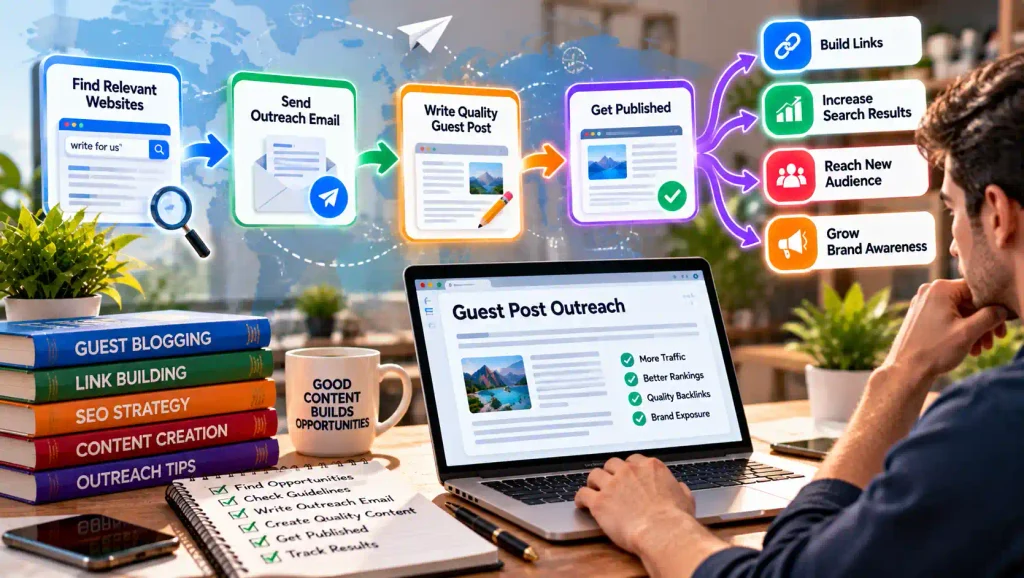
How Does Guest Post Outreach Work?
Guest post outreach starts with research and planning. You identify websites related to your niche, review their content, and check whether they accept guest contributions. Then, you contact the right editor or website owner with a relevant topic idea.
A successful guest posting outreach process focuses on website relevance, useful content, and personalized communication. Here are the main steps.
1. Find Relevant Websites
Search for websites that publish content related to your industry. Look for blogs, online publications, and businesses whose audiences may benefit from your expertise.
2. Review Their Content Quality
Read a few recent articles to understand the site’s topics, writing style, and audience. Check whether the content provides genuine value instead of focusing mainly on publishing promotional links.
3. Check Guest Posting Guidelines
Look for pages such as Write for Us, Contribute, or Guest Post Guidelines. Review the publisher’s requirements for topics, word count, formatting, links, and submissions.
4. Find the Right Contact Person
Identify the editor, content manager, or website owner responsible for submissions. Use the contact details provided on the website rather than sending the same message to unrelated departments.
5. Identify Content Gaps
Review existing articles and look for useful topics the website has not covered well. Your idea should complement its current content rather than repeat an article that already exists.
6. Suggest a Relevant Topic
Choose a specific topic that matches the site’s audience and editorial standards. Explain briefly why the proposed article would be useful to its readers.
7. Write a Clear Email Subject Line
Use a short, relevant subject line that tells the recipient why you are contacting them. Avoid misleading wording, excessive promotional language, or clickbait.
8. Send a Personalized Pitch
Introduce yourself briefly, mention a relevant article from the website, and explain your proposed topic. Keep the message professional and focused on the value you can offer.
9. Follow Up Professionally
If you do not receive a reply, consider sending one polite follow-up after several business days. Avoid repeated messages that could annoy the editor or damage your professional relationship.
10. Write and Submit the Article
Wait for the publisher’s approval before writing a full article, unless its guidelines request a complete draft. Follow the agreed topic, formatting requirements, and editorial rules. Make sure any links are relevant and comply with the publisher’s policies.
The goal of guest post outreach is to build genuine publishing relationships and contribute useful content—not simply to obtain as many backlinks as possible. standards, choose suitable topics, contact the publisher, pitch the idea, and submit the article for review.
Why Is Guest Post Outreach Important?
Many websites accept guest articles, but they usually have editorial guidelines and approval processes. You often need to contact an editor or website owner before submitting your content.
Guest post outreach helps you introduce yourself, suggest relevant topics, and explain how your article could benefit the publisher’s audience.
A well-planned outreach campaign can help you:
- Reach a new audience: Share your expertise with readers who may not know your business.
- Build publisher relationships: Connect with editors and website owners in your industry.
- Generate referral traffic: Attract visitors who click through to your website.
- Increase brand awareness: Help more people discover your business and expertise.
- Share useful knowledge: Contribute practical information that answers readers’ questions.
- Earn relevant backlinks: Gain editorial links when publishers choose to include them naturally and their linking policies allow them.
- Develop long-term partnerships: Build professional relationships that may lead to future contributions and collaborations.
However, successful guest post outreach should benefit both sides. You gain an opportunity to reach a relevant audience, while the publisher receives useful content that meets its readers’ needs.
The focus should be on providing value and building genuine relationships, rather than pursuing backlinks at any cost.
How to Find Websites That Accept Guest Posts
The first step in guest post outreach is finding websites that publish content related to your niche. Start with search engines and use targeted phrases to discover publishers that accept guest contributions.
Try searches such as:
"write for us" + your niche"guest post" + your niche"submit an article" + your niche"become a contributor" + your niche"guest blogging" + your niche"contribute" + your niche
For example, if you work in digital marketing, search for "write for us" digital marketing or `”become a contributor” SEO. These searches can help you discover websites with public submission guidelines.
However, do not rely only on websites with a dedicated guest posting page. Some relevant publications accept expert contributions through their editorial teams, even if they do not advertise guest posting opportunities.
You can also review industry blogs, online magazines, and websites that publish articles from outside contributors. Before contacting any publisher, check its content quality, audience, topical relevance, and submission requirements.
The goal is to find websites where your proposed article would genuinely help readers—not simply to collect a long list of sites offering backlinks.
How to Choose Good Guest Posting Websites
Finding websites that accept guest posts is only the first step. Before contacting a publisher, check whether its website is relevant, trustworthy, and suitable for your audience.
Review these factors:
- Topic relevance: Choose websites that cover subjects related to your industry.
- Content quality: Check whether their articles provide useful information, original insights, and clear explanations.
- Audience: Consider whether the site’s readers are likely to be interested in your expertise or services.
- Recent articles: Review recent posts to see whether the website publishes content consistently.
- Organic visibility: Look at available search visibility data, but do not reject a legitimate website based only on low estimated traffic.
- Editorial standards: Check whether articles are reviewed, edited, and published according to clear guidelines.
- Website history: Look for signs of a genuine publication with a consistent topic and a credible publishing record.
- Link policies: Review how the site handles external links, sponsored content, and contributor links.
- Publishing frequency: Check whether the website maintains a reasonable publishing schedule and prioritizes useful content.
The best website is one that fits your niche and offers genuine value to its readers. For example, if your business provides SEO services, a digital marketing publication is usually more relevant than an unrelated entertainment blog.
A smaller niche website with an engaged, relevant audience may be more useful for your goals than a larger website covering unrelated topics. Do not judge a publisher by a single SEO metric; consider its relevance, content quality, audience, and editorial practices together.
Find Content Gaps Before Outreach
Finding content gaps can improve your pitch.
A content gap is a useful topic that a website has not covered well yet.
Before sending your email, study its existing articles.
Ask:
- What topics are missing?
- Which articles are outdated?
- What questions are not fully answered?
- Can I provide a new example?
- Can I offer a different angle?
- What would help its readers?
For example, imagine a marketing blog has many SEO articles but no clear guide about international SEO.
You could pitch an article about that topic.
This makes your pitch more specific and useful.
How to Find the Right Contact Person
Finding the right contact person can improve your guest post outreach. Your pitch is more likely to reach the appropriate person when you contact someone who handles article submissions or editorial decisions.
Depending on the website, the right contact may be:
- Website owner: Often handles submissions on smaller websites.
- Editor: Reviews article ideas and decides which content to publish.
- Content manager: Oversees the website’s content strategy and publishing schedule.
- Blog manager: May manage blog contributions and article submissions.
- Marketing manager: May handle partnerships or branded content opportunities.
- SEO manager: May be involved when the proposal relates to content partnerships or organic search.
Start by checking the website’s Contact, About, Team, Write for Us, Contributor, or Author pages. These pages may list submission instructions or identify the person responsible for editorial decisions.
You can also review the company’s professional social media profiles to find relevant team members. If the website provides a specific submission form or editorial email address, follow those instructions first.
Avoid sending the same pitch to every email address you find. Choose the most relevant contact, personalize your message, and explain why your proposed article would benefit the website’s readers.
Write a Strong Subject Line
Your email subject line is one of the first things an editor sees when they receive your guest post outreach pitch. Keep it short, clear, and relevant to the website’s content.
Here are a few examples:
- Guest Post Idea: Technical SEO Tips for Small Businesses
- Article Idea for [Website Name]
- Guest Article Proposal: Improving Website Speed
- Content Idea for Your Digital Marketing Blog
Choose a subject line that reflects the actual topic of your email. If possible, tailor it to the publication rather than using the same generic subject for every website.
Avoid misleading claims, excessive promotional language, or clickbait. The editor should quickly understand why you are contacting them and what your message is about.
A clear, relevant subject line helps your pitch look professional, although it cannot guarantee that the editor will open or accept your proposal.
How to Write a Guest Post Pitch
A good guest post pitch should be clear, concise, and relevant to the publication. Editors and website owners may receive many emails, so get to the point and explain why your proposed article would be useful to their readers.
Your outreach email should include:
- A short introduction: Explain who you are and what you do.
- A relevant reason for contacting the website: Mention why the publication fits your topic or expertise.
- A specific topic idea: Suggest a clear article title or subject that matches the website’s content.
- Reader benefits: Briefly explain what readers will learn from your proposed article.
- Relevant writing examples: Share one or two published articles that demonstrate your writing experience, if available.
- A polite closing: Ask whether the editor would consider the idea and thank them for their time.
Before sending your pitch, read a few articles on the website and follow its guest contribution guidelines. Personalize your message with a genuine detail about the publication instead of sending the same email to every editor.
Keep the email focused on the proposed content and its value to readers. Avoid exaggerated claims, irrelevant links, and lengthy introductions.
A personalized pitch helps establish a professional first impression, although the publisher still decides whether the topic fits its editorial plans.
Personalize Your Outreach
Personalization is an important part of successful guest post outreach. Editors are more likely to understand the value of your proposal when your message shows that you have researched their website.
Avoid sending generic messages such as:
“Hello sir, I want guest post. Please reply.”
Instead, read a recent article, review the website’s main topics, or identify a subject that could be useful to its readers. Use that research to make your pitch more relevant.
For example:
“I enjoyed your recent guide to local SEO, especially the section on Google Business Profile. I have an idea for a practical article about local citations that could complement your existing content and give readers another useful resource.”
This approach shows that you understand the publication and have considered how your idea fits its content.
You do not need to write a long personalized email. A brief, genuine reference to the website and a relevant topic suggestion can make your message more specific and professional. Avoid pretending to have read an article or praising a website if you have not actually reviewed it.
Why Quality Content Matters
Getting your guest post pitch accepted is only the first step. You still need to create quality content that meets the publisher’s editorial standards and provides value to its readers.
Before writing, take time to understand:
- The audience: Identify who reads the website and what information they need.
- Popular topics: Review existing articles to understand which subjects the publication covers.
- Writing style: Follow the site’s tone, formatting, and preferred article structure.
- Reader questions: Address practical questions that are relevant to the topic.
- Editorial guidelines: Follow the publisher’s requirements for word count, formatting, images, sources, and links.
Your article should feel like a natural fit for the website. It should offer useful information, original insights, and clear explanations rather than read like an advertisement for your business.
Avoid adding links simply to promote your services. Include references only when they are relevant and helpful, and follow the publisher’s link policies.
High-quality guest content benefits both sides: readers receive useful information, while the publisher gets an article that supports its editorial goals. This can also help you build lasting relationships with editors and other publishers.d guest post should provide genuine value and feel like a natural part of the publication.
Guest Post Outreach and Link Building
Guest posting is often connected with link building.
Some guest articles may include a relevant link to the writer’s website.
This can help readers discover another useful resource. It may also support a wider backlink profile, depending on the link and its context.
However, you should not use guest posting only to build links.
The article should have value even if nobody clicks your link.
Focus on the audience first.
Relevant content and natural links create a more sustainable approach than publishing low-quality articles simply to get backlinks.
Use Natural Links
When a publisher allows links, include them only when they provide useful context or help readers explore a topic in more detail. Every link should have a clear purpose and fit naturally into the article.
For example, if your guest article explains technical SEO, linking to a detailed guide about XML sitemaps can help readers understand the topic further. However, a link to an unrelated service page would add little value.
Use descriptive anchor text that accurately explains the linked page. Avoid forcing exact-match commercial keywords into sentences or repeating the same keyword-rich anchor text across multiple guest articles to manipulate search rankings.
Also, follow the publisher’s linking guidelines. Some websites allow links to relevant resources, while others restrict promotional links or require paid placements to be appropriately disclosed and qualified.
The goal is to make every link useful to readers, not simply to obtain a backlink. Relevant, editorially appropriate links support a better user experience and help keep your guest content natural.
How to Improve Outreach Response Rates
Not every publisher will reply to your guest post outreach email, and that is normal. Editors may be busy, your topic may not fit their current plans, or the website may not be accepting contributions.
Your outreach response rate can depend on several factors, including website relevance, email quality, topic selection, timing, and the publishers you contact.
You can improve your approach by:
- Contacting relevant websites: Focus on publishers whose audiences match your expertise.
- Personalizing each email: Show that you understand the website and its content.
- Writing a clear subject line: Make the purpose of your message easy to understand.
- Suggesting useful topics: Offer ideas that fit the publication and its readers.
- Keeping your message concise: Explain your proposal without unnecessary details.
- Sharing relevant writing samples: Include examples that demonstrate your experience, when available.
- Following editorial guidelines: Use the website’s preferred submission process.
- Following up politely: If you receive no reply, consider one brief follow-up after several business days.
Track your outreach efforts to identify which topics, publishers, and email approaches receive the best responses. Use those observations to improve future campaigns rather than sending more emails without a clear strategy.
Remember, the goal is not to get a positive response from every publisher. It is to build relevant relationships and make thoughtful proposals to websites that are a good fit for your content.
Should You Follow Up?
Yes, a polite follow-up can help if you do not receive a reply to your guest post outreach email. Editors often manage multiple submissions and deadlines, so your first message may be overlooked.
Wait several business days before following up. Keep your message brief, refer to your original email, and ask whether the proposed topic might be a good fit. Avoid sending repeated messages every day.
Example follow-up email:
Subject: Following Up on My Guest Post Idea
Hi [Name],
I wanted to follow up on my previous email about a possible guest article on [Topic]. I believe it could provide useful information for your readers.
If the idea fits your editorial plans, I would be happy to share more details. Thank you for your time.
Best regards,
[Your Name]
If you still do not receive a response after one polite follow-up, consider moving on to other relevant publishers. Repeated messages can damage professional relationships, while respectful communication helps keep future opportunities open.
Guest Blogging and Social Media
Social media can support your guest post outreach by helping you discover relevant websites, connect with editors, and build professional relationships.
You can use professional networks such as LinkedIn to:
- Find editors: Identify editors, content managers, and website owners in your niche.
- Follow publishers: Keep up with websites that publish content related to your industry.
- Research content: Learn about recent articles, audience interests, and upcoming topics.
- Discover opportunities: Find publications that welcome expert contributions or guest articles.
- Build relationships: Engage with relevant posts and take part in genuine industry discussions.
- Share published articles: Promote your guest contributions when the publisher permits it.
Avoid sending promotional messages to everyone you connect with. Take time to understand their work and make contact when you have a relevant reason to do so.
Social media does not guarantee guest post placements, but it can help you build professional connections. Over time, these relationships may lead to useful long-term guest blogging opportunities beyond cold email outreach alone.
Think About Long-Term Relationships
A successful guest post does not have to be a one-time project. When you provide useful content and communicate professionally, an editor may invite you to contribute again.
Building long-term relationships with publishers can make your guest post outreach more effective over time.
After your article is published, follow these practices:
- Thank the editor: Send a short message to appreciate their time and support.
- Share the article: Promote the published post through your professional channels when appropriate.
- Stay responsive: Reply promptly if the editor asks questions or provides feedback.
- Maintain content quality: Make sure future contributions meet the publisher’s editorial standards.
- Keep in touch professionally: Contact the editor when you have a genuinely relevant idea or opportunity.
Avoid contacting publishers only when you need a backlink. Focus on providing value and maintaining a professional relationship.
A trusted publisher relationship can lead to repeat contributions, new content opportunities, and stronger industry connections. It can also save time because you already understand the website’s audience and editorial requirements.
Common Guest Post Outreach Mistakes
Several mistakes can reduce the effectiveness of your guest post outreach campaign. Avoid these common problems when contacting publishers. (see our guide on guest post outreach mistakes)
- Sending generic emails: Personalize each pitch instead of sending the same message to every editor.
- Contacting unrelated websites: Choose publishers whose topics and audiences match your expertise.
- Ignoring content gaps: Suggest useful topics that complement the website’s existing articles.
- Writing vague subject lines: Use a clear subject that explains the purpose of your email.
- Sending lengthy promotional emails: Keep your message concise and focus on the value of your proposed article.
- Demanding backlinks immediately: Discuss your content idea first and respect the publisher’s linking policies.
- Ignoring submission guidelines: Follow the website’s requirements for topics, formatting, and article submissions.
- Submitting low-quality content: Provide original, accurate, well-organized information that benefits readers.
- Overusing keyword-rich anchor text: Use natural, relevant links instead of repeatedly forcing exact-match keywords into articles.
- Following up too frequently: Allow editors time to respond and avoid sending repeated messages.
- Relying only on SEO metrics: Consider topical relevance, content quality, audience fit, and editorial standards rather than judging a website by one metric.
Remember that guest post outreach involves communicating with real people. A clear, respectful, and relevant message gives editors a better reason to consider your proposal. Focus on building genuine publishing relationships instead of treating every email as a request for a backlink.
Guest Post Outreach and Search Results
Guest post outreach does not guarantee better search results or higher rankings. Search engines use many signals to evaluate pages, and no single marketing activity can ensure a specific ranking.
However, guest blogging can support your wider digital marketing strategy in several ways. Publishing useful content on relevant websites can help you reach new audiences, build industry relationships, increase brand awareness, and attract referral traffic.
Relevant links may also support SEO when they are editorially appropriate and earned naturally. However, guest posts created mainly to manipulate rankings through keyword-rich links can violate search engine spam policies.
For the best results, combine guest post outreach with high-quality website content, effective on-page SEO, sound technical SEO, and other relevant marketing activities.
Focus on publishing useful articles and building genuine relationships rather than treating guest posting as a guaranteed shortcut to higher rankings.
Frequently Asked Questions
What Is Guest Post Outreach?
Guest post outreach is the process of finding relevant websites and contacting their owners or editors to propose useful guest articles. It typically involves researching websites, choosing topics, sending pitches, and following editorial guidelines.
How Do I Find Websites Accepting Guest Posts?
Search for relevant websites using phrases such as “write for us,” “guest post,” and “become a contributor.” You can also approach suitable publications directly if they accept outside contributions.
How Can I Improve Guest Post Response Rates?
Research each website, personalize your email, use a clear subject line, and suggest a topic that benefits its readers. Keep your pitch concise and send a polite follow-up if needed.
Is Guest Post Outreach Good for Link Building?
Guest post outreach can help you earn relevant editorial links when publishers consider them appropriate. Focus on useful content and genuine audience value rather than using guest posts primarily to manipulate search rankings.
How Long Should a Guest Post Pitch Be?
There is no fixed word count. Keep your email brief and explain who you are, what topic you propose, and why it would benefit the publication’s readers.
Is Guest Post Outreach a Long-Term Strategy?
Yes, it can be part of a long-term marketing strategy. Professional relationships with editors and website owners may lead to repeat contributions, referral traffic, and future collaboration opportunities.
Final Thoughts
So, what is guest post outreach? It is the process of finding relevant publishers and proposing guest articles that provide value to their readers.
Successful outreach starts with research. Choose websites that match your niche, review their content, and check their submission guidelines. Then contact the right person with a clear subject line and a personalized pitch.
If a publisher accepts your idea, create high-quality content that meets its editorial standards and helps its audience.
Remember, guest post outreach is about more than backlinks. It can help you build industry relationships, increase brand awareness, attract referral traffic, and create future publishing opportunities.
Focus on relevant websites, useful content, and genuine professional relationships. By making these priorities part of your wider content marketing strategy, you can approach guest post outreach in a more sustainable and effective way.
Related reading: most placements are won in the follow-up — master the guest post follow up email with exact timing and 3 copy-paste templates. Explore more: 7 Guest Post Pitch Examples That Got Accepted (2026) and 10 Best Guest Post Outreach Tools Compared (2026).
One Response