Someone arrested at 11 PM does not scroll. They search “DUI lawyer near me” and call the first firm that looks trustworthy. That moment — urgent, local, high-stakes — is why this guide to SEO for law firms exists. Legal clients are the most valuable clicks in all of search marketing: a single signed personal injury case can be worth tens of thousands of dollars.
But ranking for legal keywords follows different rules than ranking for anything else. Google treats legal content as YMYL (Your Money or Your Life) and applies its strictest quality standards, and every state bar has advertising rules that can punish aggressive marketing.
This playbook covers the 7 steps that actually move the needle in 2026, including the ethics-safe approach to SEO for law firms that most generic guides skip.
Why SEO for Law Firms Is Different
Before the tactics, understand the three forces that make legal SEO its own discipline:
- YMYL scrutiny: Google demands maximum E-E-A-T (Experience, Expertise, Authoritativeness, Trustworthiness) from legal sites. Thin content does not just underperform — it can be actively suppressed.
- Bar advertising rules: Every US state regulates attorney advertising. Misleading claims, unqualified testimonials, and unverifiable “specialist” titles can trigger ethics complaints. Your SEO for law firms strategy must be compliant by design.
- Emergency intent: A large share of legal searches happen in crisis moments — arrests, accidents, urgent family matters. Speed, mobile experience, and instant contact options matter more here than in almost any other niche.
Step 1: Target Keywords That Signal “Ready to Hire”
Legal keywords — the battleground of SEO for law firms — are among the most expensive in Google Ads — a click on “personal injury lawyer” in a major city can cost over $200. That is exactly why organic rankings pay off so well. But volume is the wrong metric. Target intent.
The high-conversion formula: [Practice Area] + [Legal Identifier] + [Location]. Examples: “car accident attorney Chicago,” “divorce lawyer Tampa FL,” “workers comp attorney near me.”
Build your keyword list in three tiers:
- Tier 1 — Transactional: “hire,” “near me,” “consultation,” “cost” modifiers. These are your money pages.
- Tier 2 — Emergency: “DUI lawyer open now,” “emergency custody attorney,” “24 hour bail attorney.” Lower volume, highest conversion rate.
- Tier 3 — Informational: “how long does a divorce take in Texas?” These build authority and feed AI Overviews — but they should support, not replace, your money pages.
For the research process itself, see our guide on how to do keyword research — the same framework applies to SEO for law firms, with intent tiers doing the heavy lifting.
Step 2: Build Practice Area Pages That Convert
Your practice area pages are the foundation of SEO for law firms. Each one should be a complete, trustworthy resource for one service in one market — not a 300-word brochure.
Every practice area page needs:
- The primary keyword in the H1, URL slug, and first 100 words
- A named attorney author with a bio showing bar admissions and credentials
- Real, specific information: fee structures, timelines, what happens at the first consultation
- LegalService and Attorney schema markup (more on schema below)
- A click-to-call phone number above the fold on mobile
- Internal links to related practice pages, forming a clear site architecture
One page per practice area per location. Do not build city pages for cities where you have no office, no attorney, and no case history — Google’s helpful content systems penalize manufactured location pages.
Step 3: Win the Local Map Pack
For most firms, the Google Map Pack (the three map listings above organic results) is the single highest-ROI channel in SEO for law firms. Over 70% of legal searches carry local intent, and the map pack captures the majority of clicks and calls.

Google Business Profile optimization checklist:
- Claim and verify your profile; choose the most precise primary category (“Personal Injury Attorney,” not just “Lawyer”)
- Add all relevant secondary categories (up to 9) covering your practice areas
- Write a keyword-rich 750-character business description — and include your state bar registration number as a trust signal
- Upload at least 10 real photos: office exterior, interior, team headshots
- Publish weekly Google Posts with legal tips or case updates
- Keep hours accurate, including 24/7 availability if you offer it — emergency searches filter by “open now”
- Respond to every review, positive and negative, within 24 hours
Reviews are your reputation moat. A firm ranked third with 4.9 stars from 90 reviews routinely out-converts a firm ranked first with 3.8 stars. But review solicitation has ethics constraints: never incentivize clients for positive reviews — most state bars treat that as a rule violation. Instead, build review requests into your normal case-closing process: a post-matter email, an SMS follow-up, or a client portal notification. For the full GBP playbook, see our Google Business Profile optimization guide.
Step 4: Make Your Attorneys the E-E-A-T
In legal SEO, E-E-A-T is not abstract — it is people. Google wants to see that real, credentialed attorneys stand behind the content. The standard Google applies to SEO for law firms rewards firms that make their lawyers visible and verifiable.
- Attorney bio pages: bar admissions, certifications, education, speaking engagements, media appearances. Link every bio to the firm’s LinkedIn and state bar profile.
- Named authorship: every article gets a named attorney author with a byline linking to their bio — never “Admin” or anonymous posts.
- Case results: published verdicts and settlements (anonymized where required) are the strongest experience signals a firm can show. Create a dedicated case-results section, not just a testimonial slider.
- Attorney schema: mark up bio pages with Attorney schema and the site with LegalService schema. Validate with Google’s Rich Results Test before deploying. Google’s official docs on local business structured data cover the implementation.
Step 5: Earn Links the Legal Way
Legal link building — a cornerstone of SEO for law firms — is about a small number of authoritative, relevant links — not volume. The sources that move rankings for firms:
- Legal directories: Avvo, Justia, FindLaw, Martindale-Hubbell. High authority — and optimize the profiles themselves, because these directory pages often rank for “best [practice] lawyer [city]” queries.
- State and local bar associations: membership directories and speaking pages are among the most trusted links in legal SEO.
- Law school alumni networks: .edu links from alumni profiles and guest lectures carry exceptional weight.
- Legal journalism: get quoted as an expert source. Reporters covering court decisions need attorney commentary — that is editorial link gold.
- Case-result content as link bait: a well-documented “$2.3M truck accident settlement” page with anonymized facts earns links from legal blogs and news roundups. Build the page with proper disclaimers (see Step 6).
Step 6: Keep Every Tactic Ethics-Compliant
This is the section most law firm SEO guides skip — and the one that protects your license. The ABA Model Rules (7.1–7.3) and state equivalents govern attorney communications, and they apply to your website and SEO content. Practical rules:
- No misleading claims: never imply outcomes (“we win every case”) or use unverifiable superlatives (“the best DUI lawyer in Texas”) without substantiation.
- Testimonial disclaimers: client testimonials are allowed in most states but must not create unjustified expectations. Pair results with disclaimers like “past results do not guarantee future outcomes” — and check your state’s specific rule.
- “Specialist” is a regulated word: in many states you cannot call yourself a “specialist” or “expert” in a practice area without formal board certification. Use “focuses on” or “practices in” instead.
- No fake reviews, ever: fabricated reviews violate both Google’s policies and bar rules — and competitors report them.
- Fee transparency: advertising “free consultation” when the consultation is actually a sales call can draw complaints. Be precise about what “free” includes.
When in doubt, have your state bar’s advertising rules reviewed by ethics counsel before a big content push. One complaint costs more than any ranking is worth.
Step 7: Track Signed Cases, Not Just Rankings
Rankings and traffic are leading indicators. The only metric that pays the bills is signed retainers. Most SEO for law firms fails at measurement — firms celebrate page-one rankings while the intake team quietly misses calls.
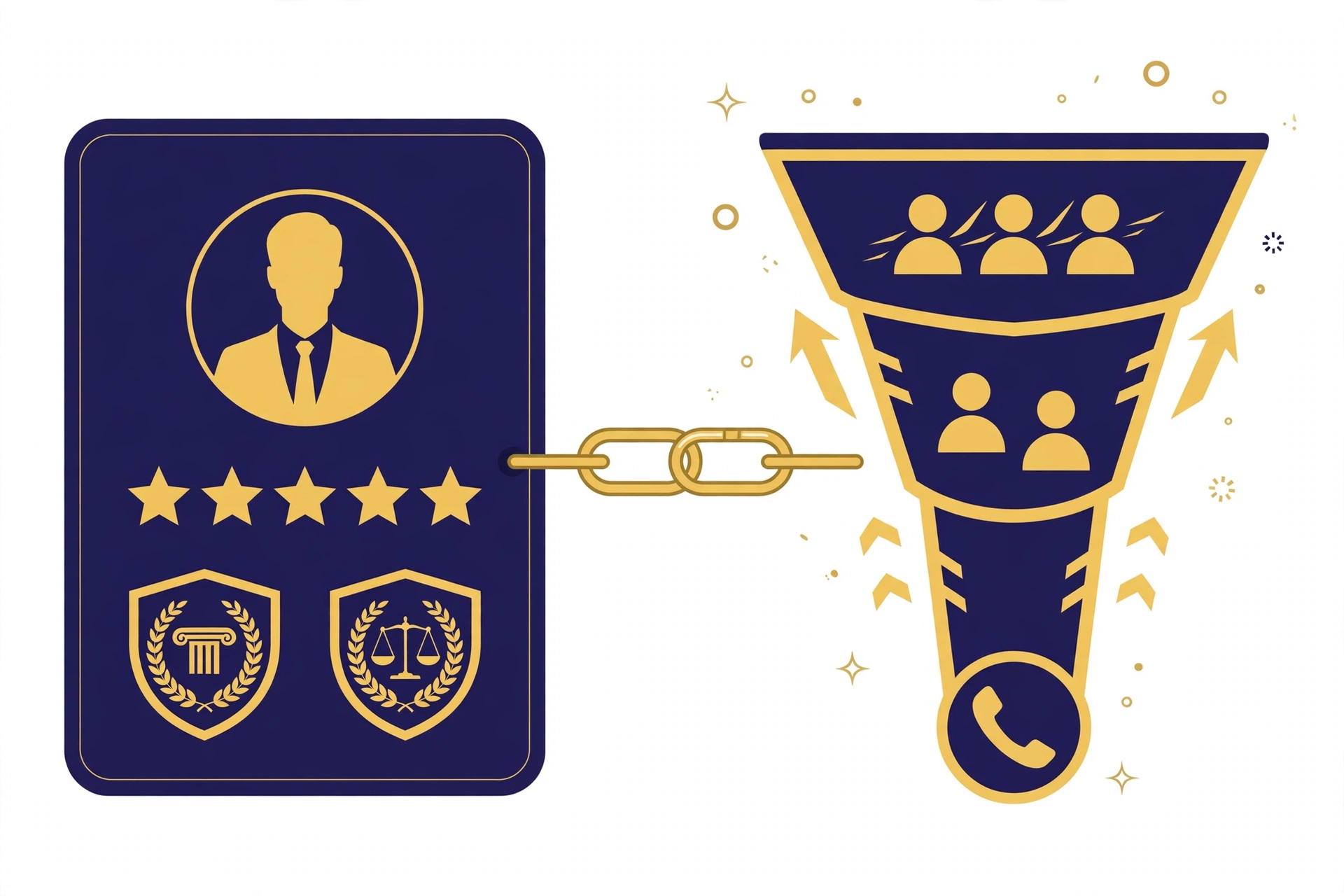
Build a case-attribution system:
- Call tracking: assign unique phone numbers per landing page so you know which pages generate calls.
- UTM-tagged GBP links: append UTM parameters to your Google Business Profile website link so GA4 attributes those sessions correctly instead of misclassifying them as direct traffic.
- CRM source tagging: tag every lead with its organic source page. A practice area page that ranks #5 but signs 3 cases a month beats a #1 blog post that signs none.
- Speed-to-lead: track response time. Legal leads decay fast — firms that respond within 5 minutes convert dramatically better than firms that respond in an hour.
For the analytics setup, our Google Search Console guide walks through the Search Console side of measurement.
5 Mistakes That Kill Law Firm SEO
- One website, fifty cities: in SEO for law firms, thin duplicate city pages with the city name swapped in are a classic trap. Google penalizes them and they convert nobody.
- Stock-photo attorneys: generic gavel images and faceless content destroy the trust signals YMYL content needs. Show your real people.
- Ignoring Core Web Vitals: a 4-second load time on a “24/7 emergency attorney” page is a contradiction. Keep LCP under 2.5 seconds — see our Core Web Vitals guide.
- Blogging without a plan: 200 generic “what is a DUI” posts that AI Overviews summarize away. Every post should target a query your money pages cannot and link up to them.
- Buying links: paid link schemes violate Google’s spam policies and — for attorneys — can look like improper solicitation. Earn links or skip them.
Frequently Asked Questions
How long does SEO for law firms take to show results?
Expect 4–6 months for movement on low-competition local terms and 6–12 months for competitive practice-area keywords like “personal injury lawyer [city].” Map pack improvements from GBP optimization and reviews often appear faster — sometimes within 30–60 days.
How much should a law firm budget for SEO?
Competitive markets typically require $3,000–$10,000 per month for a full program (content, technical, links, local). Solo and small firms in less competitive practice areas can start around $1,500–$3,000. Given legal CPCs above $200, even one signed case per quarter usually covers the investment.
Can a law firm do SEO in-house?
Yes for the basics: GBP management, review generation, and attorney-authored content are best done in-house anyway. Most firms outsource technical SEO, link building, and schema implementation while keeping content and reputation work internal.
Do Google Business Profile reviews really affect rankings?
Yes. Reviews are one of the top local pack ranking factors for SEO for law firms (roughly 15–20% of the weight in industry studies), and they are the primary conversion signal once you appear. Quantity, recency, rating, and response rate all matter.
Is SEO or PPC better for law firms?
Both have a role. PPC delivers immediate cases while SEO builds; SEO compounds and lowers cost-per-case over time. Most firms run both: ads for instant intake, SEO for durable, defensible lead flow. The math favors SEO for law firms once rankings mature because legal clicks are so expensive.
Can SEO get my firm cited in AI Overviews?
Yes, with the right structure: named attorney authors, direct-answer FAQ sections, jurisdiction-specific facts, and clean schema make your pages extractable. Google’s SEO starter guide covers the fundamentals that AI citation builds on.
Conclusion
SEO for law firms is a long game played under stricter rules than any other niche — YMYL scrutiny, bar advertising regulations, and emergency-driven clients who decide in seconds.
The firms that win at SEO for law firms in 2026 do the unglamorous work: precise practice-area pages with named attorney authors, a fully optimized Google Business Profile, ethics-safe review generation, authoritative legal links, and measurement tied to signed cases.
Start with the map pack and your money pages, layer in content and links, and keep every tactic inside your bar’s rules. Not sure where your firm stands? Get a free SEO audit and see exactly what is holding your rankings back.