SEO for SaaS: The 2026 Playbook (7 Steps)

SEO for SaaS needs bottom-of-funnel pages, product-led assets, and clean rendering. This 7-step guide covers keywords, comparison pages, technical checks, and AI.
How to Measure SEO ROI: A Practical Guide for 2026

Every budget review ends with the same uncomfortable question: “This SEO work costs real money — what exactly is it earning us?” If you cannot answer with numbers, your SEO budget is the first one cut when money gets tight. Learning how to measure SEO ROI is what separates SEO treated as a cost center from SEO treated as a growth engine. SEO ROI is simply the revenue your organic search work generates compared to what you spend on it. The formula takes ten seconds to write down. Getting honest numbers for both sides of it — that is where most businesses fail, and why so many SEO programs get undervalued or killed too early. This guide walks you through the complete process: the exact formula, what to count as cost (most teams undercount by half), how to put a dollar value on organic conversions for your business model, and the GA4 and Search Console setup that makes your data trustworthy. You will also learn the metrics most guides skip — like the ad spend your rankings quietly save you — and how to forecast returns before you invest a single dollar. By the end of this guide, how to measure SEO ROI will feel less like accounting homework and more like a dashboard you check with confidence. How to Measure SEO ROI: The Core Formula Strip away the jargon and how to measure SEO ROI comes down to one equation: SEO ROI = ((Revenue from organic search − Total SEO cost) ÷ Total SEO cost) × 100 Here is what it looks like with real numbers. Say you spend $6,000 per month on SEO — agency fees, content, and tools combined. Over the same period, organic search drives $30,000 in attributable revenue. The math: (($30,000 − $6,000) ÷ $6,000) × 100 = 400% That means every dollar you put into SEO returned four dollars of profit on top of the original dollar. The formula is the easy part. The hard part — and the part this guide focuses on — is calculating the two inputs honestly. Memorize the equation, but obsess over the inputs — that discipline is what how to measure SEO ROI is really about. The Two Numbers That Decide Everything Every flawed attempt at how to measure SEO ROI fails in the same two places: the cost is undercounted, the revenue is misattributed, or both. Get these two numbers right and the rest is arithmetic. 1. Your true SEO cost (it is bigger than you think) Most businesses calculate ROI using only their agency retainer or their SEO tool subscriptions. That can understate the real investment by 50% or more. A complete cost picture includes: Agency retainer or freelancer fees In-house staff time spent on SEO (use salary share, not zero) Content production: writers, editors, designers, videographers Developer time for technical fixes and implementation SEO software, analytics tools, and rank trackers Link acquisition and digital PR costs Project management and reporting time A $4,000 monthly retainer plus $2,000 of staff time, $1,500 of content, and $500 of tools is not a $4,000 investment — it is an $8,000 one. Use the smaller number and your ROI looks twice as good as it really is, which feels nice until someone makes budget decisions on it. For a realistic sense of market rates, see our breakdown of how much SEO costs in 2026. 2. Your true organic value (by business model) How you convert organic traffic into dollars depends on how you make money: Ecommerce: revenue from organic transactions (net of refunds if possible). Lead generation: organic leads × lead-to-sale rate × average revenue per sale. SaaS: organic signups × trial-to-paid rate × average first-year revenue. Local services: organic calls and bookings × close rate × average job value. Example for lead gen: 60 organic leads per month × 20% close rate × $5,000 average deal = $60,000 in monthly organic value. Always build the model from your own historical conversion data, not industry guesses. Pick the model that matches your business, because how to measure SEO ROI starts with defining value the same way your finance team defines it. How to Measure SEO ROI in 5 Practical Steps Theory is cheap. Here is the actual workflow, in order. Step 1: Pick your reporting window Monthly works for active management, but never judge SEO on a single month — one content launch or seasonal dip will distort everything. Track month-over-month for operations and trailing 12-month for real ROI decisions. The longer your sales cycle, the longer the window needs to be. Step 2: Set up conversion tracking in GA4 You cannot measure revenue from organic search if conversions are not tracked. In GA4, mark every money-adjacent action as a key event: purchases, form submissions, demo bookings, trial signups, quote requests, and phone calls over a minimum duration. Google’s own documentation walks through key event setup step by step. Step 3: Isolate the organic channel In GA4 reports, filter conversions by the Organic Search channel. This is your direct organic revenue. Then check assisted conversions — buyers who first found you through organic search but converted later through another channel. Ignoring assisted conversions is the single most common reason SEO gets undervalued, especially in B2B where buying cycles stretch across weeks and multiple touchpoints. Step 4: Assign dollar values to every conversion Ecommerce is straightforward: use transaction revenue. For everything else, multiply volume by your real close rates and deal values (see the business-model formulas above). Connect your CRM stages — marketing qualified, sales qualified, opportunity, closed won — so a “lead” stops being a vanity number and becomes pipeline. Step 5: Run the formula and track the trend This is the point where how to measure SEO ROI becomes a habit instead of a one-off exercise: plug your totals into the formula, then plot the result over time. A healthy SEO program shows a rising curve: modest or even negative ROI in months 1–6, break-even around months
How to Find Long Tail Keywords: 7 Free Methods That Work in 2026

Long tail keywords are the specific, multi-word search phrases that carry clear intent — and they are the easiest traffic a small or mid-size site can win in 2026. While everyone fights over head terms like “seo services” or “running shoes,” thousands of longer phrases sit nearly untouched, searched by people who know exactly what they want. This guide shows you how to find long tail keywords using 7 completely free methods, how to score them so you only chase winners, and how to turn them into content that actually ranks. You will also get a full worked example for a local business and a section on what to do when your site is brand new and has zero data. No paid tools required. If you want the bigger picture first — the full journey from seed topic to published content — start with our guide on how to do keyword research, then come back here for the long-tail deep dive. What Are Long Tail Keywords? A long tail keyword is a highly specific search phrase, usually three or more words, that describes exactly what the searcher wants. Compare: Head keyword: “running shoes” — 100,000+ searches a month, dominated by Nike, Adidas, and Amazon. Long tail keyword: “best running shoes for women with flat feet” — a few hundred searches a month, weak competition, and a searcher halfway to buying. The name comes from the shape of the search-demand curve: a few head terms get massive volume (the head), while millions of specific phrases each get a little (the long tail). Add them up and the tail holds the majority of all searches. Here is the part most guides get wrong: word count is not the real definition. Specificity and intent are. A two-word phrase like “vegan accountant” behaves exactly like a long tail keyword — low volume, narrow intent, minimal competition. Judge a keyword by how specific the intent is, not by counting words. Why Long Tail Keywords Matter More in 2026 Three shifts made long tails more valuable than ever this year. First, AI search runs on long-tail phrasing. People do not type “CRM” into ChatGPT or Perplexity — they ask full questions like “what is the best CRM for a 10-person real estate team?” AI answers and Google AI Overviews quote content that resolves specific questions. Optimizing for long tail keywords and optimizing for AI citations is now the same activity. Second, conversion math favors specificity. A visitor who searched “dental implants cost with bone graft” is incomparably closer to booking than one who searched “dentist.” Fifty visitors with precise intent routinely outperform five thousand vague ones. Third, they are winnable. Big domains ignore phrases with 50 monthly searches. That leaves the door open for smaller sites to rank in weeks instead of years — provided the content genuinely answers the query. How to Find Long Tail Keywords: 7 Free Methods Every method below costs nothing. Use at least three of them and you will have more long-tail ideas than you can publish. Method 1: Mine Google Autocomplete Type your seed topic into Google and stop before pressing Enter. The dropdown suggestions are real searches typed by real people recently. Each one is a ready-made long tail keyword. Force more suggestions with the alphabet trick: type your seed plus a letter — “dental implants a,” “dental implants b,” and so on. Each letter surfaces a fresh batch. Add question words too: “dental implants how,” “dental implants vs,” “dental implants for.” Ten minutes of this routinely produces 40 to 60 phrases. Method 2: Expand People Also Ask The People Also Ask box appears on almost every results page, and every question in it is a validated long tail keyword. Click one answer and Google loads two or three more questions beneath it. Keep clicking and a single seed topic can generate 20 to 30 question-format long-tails in under ten minutes. Bonus: these questions are exactly the format AI Overviews and featured snippets love. Save them verbatim — you will use them as FAQ entries later. Method 3: Harvest Related Searches Scroll to the bottom of any Google results page. The eight related searches are long-tail variants Google itself connects to your query. They reveal angles you would never think of — different phrasings, adjacent problems, and comparison queries your competitors may have missed. Method 4: Extract Queries from Google Search Console This is the most powerful free method, because it shows the exact phrases people already typed before seeing your site. Go to Performance, click “+ New,” choose Query, then “Custom (regex)” with “Matches regex,” and paste: ^[\w\W\s\S]{25,} This surfaces queries of 25 or more characters — typically the long-tail phrases. Export to a spreadsheet and filter for average position between 10 and 20. Those are pages sitting on page two or three: close enough that a content refresh or a few internal links can push them onto page one. That is the fastest ranking win available to most sites. You can get fancier: use ^[\w\W\s\S]{25,}.*how to.* to isolate informational long-tails, or swap “how to” for “best” to find commercial ones. For a deeper walkthrough of Google’s own data, see Google Search Console’s official overview. Method 5: Mine Reddit and Quora for Real Language Search site:reddit.com your topic on Google, or browse the relevant subreddit directly. The thread titles are long-tail keywords written in the exact words buyers use — often phrasings no keyword tool would ever suggest, like “is it normal for dental implants to feel weird after 6 months?” That awkward, human phrasing is precisely what converts, and it is nearly competition-free. Do the same on Quora. Sort by the questions with the most followers but the fewest good answers — high demand, low supply. Method 6: Steal Long-Tails from Weak SERPs Google your candidate long-tail phrase and look at who ranks. Green lights: forums, Reddit threads, Quora answers, or thin outdated articles in the top three. If user-generated content outranks “real” articles, Google is
Backlink Gap Analysis: Find & Steal Competitor Links (2026)

Learn how to run a backlink gap analysis: choose competitors, find domains linking to them but not you, score each gap, and plan outreach within Google’s rules.
Internal Linking Best Practices: 12 Rules That Work (2026)

These internal linking best practices are the operating rules behind every site that wins with topical authority — the difference between a pile of blog posts and a ranking machine. If you are new to the concept, start with our guide on what are internal links, then come back and apply these 12 rules one by one. Why Internal Linking Best Practices Still Move Rankings Most ranking guides treat internal links as an afterthought. That is a mistake — following proven internal linking best practices is one of the fastest ways to lift rankings. Internal links are the only ranking factor you control completely: you decide which pages get authority, which anchors describe them, and how crawlers move through your site. External backlinks may be harder to earn, but internal linking is where the fastest, cheapest ranking gains hide — especially on sites with 30+ pages that have never been linked strategically. The 12 rules below form a complete playbook: architecture, link placement, anchor discipline, maintenance, and the two advanced rules almost nobody talks about. Rule 1: Build a Pyramid, Not a Maze The foundation of all internal linking best practices is site architecture. Organize your site as a pyramid: the homepage at the top, category or pillar pages in the middle, and individual articles at the base. The homepage links to pillars, pillars link to their cluster articles, and every cluster article links back to its pillar. Why the pyramid wins: it concentrates authority where it matters, gives crawlers a predictable path, and tells Google exactly which pages are your most important. Sites that grow organically — a blog post here, a landing page there — end up as mazes where authority pools randomly and important pages sit six clicks deep. If your site grew into a maze, the fix is not more links; it is restructuring links to follow the pyramid. Rule 2: Make Contextual Body Links Your Main Weapon Not all internal links carry equal weight. A contextual link inside a paragraph of body content passes far more topical signal than the same link sitting in your navigation menu, footer, or sidebar. Template links appear on every page, so Google treats them as boilerplate — expected, not editorial. One of the simplest internal linking best practices is to audit your highest-priority links and confirm each one actually lives in body content. Apply this rule practically: your highest-priority internal links should live inside relevant body paragraphs, surrounded by text about the destination page’s topic. Navigation and footer links still matter for usability, but they will never do the ranking work that a well-placed contextual link does. When you add a link that matters, put it in the content. Rule 3: Rescue Orphan Pages Before They Die An orphan page is a page with zero internal links pointing to it. Crawlers discover pages by following links, so orphans are effectively invisible — they get crawled rarely, indexed slowly, and rank almost never. Most sites accumulate orphans silently: old campaign pages, tag archives, posts published before anyone thought about linking. The rescue workflow: once a quarter, run a crawl and filter for pages with zero inlinks. For each orphan worth keeping, add 2–3 contextual links from related, indexed pages. For orphans not worth keeping, redirect them to the closest relevant page instead of leaving them stranded. A page that deserves traffic should never have zero internal links. Rule 4: Place Priority Links in the Top 30% of the Page Link placement is positional. Links higher on the page — in the introduction and first sections — carry more weight with search engines and get more clicks from readers. A link buried after the conclusion behaves like an afterthought because, to both crawlers and users, it is one. When you publish or update an article, identify the one or two most important internal links in it and place them in the first third of the content. Reserve footer-adjacent and end-of-article positions for secondary links. If you are auditing an existing article, move its highest-value link upward rather than adding new ones — repositioning often beats addition. Rule 5: Link New Content Within 48 Hours of Publishing A new page starts with zero authority and, often, zero discovery. The fastest way to change both is to link to it from 2–3 existing, indexed pages within 48 hours of publishing. This does two things: it gets the new URL crawled and indexed faster, and it transfers immediate authority so the page starts ranking sooner instead of waiting months to earn its first backlinks. Build this into your publishing checklist as a non-negotiable step. The moment a post goes live, identify the existing articles most topically related to it and add contextual links to the new page. This single habit, applied consistently, is one of the highest-ROI internal linking best practices on this list — and it costs nothing. Rule 6: Keep Every Money Page Within 3 Clicks of the Homepage Click depth — the number of clicks from the homepage to reach a page — is a direct authority signal. Pages buried four or five levels deep receive a fraction of the crawl attention and link equity of shallow pages, no matter how good their content is. Google’s own guidance has long implied that important pages should be easy to reach, and Google’s documentation on crawlable links confirms that link structure is how crawlers discover your site. Audit your click depth with any crawler: list your revenue-driving and priority ranking pages, and check how many clicks each sits from the homepage. Anything beyond three clicks needs a shortcut — a link from the homepage, a pillar page, or a high-traffic article. Depth is not about URL length; it is about link distance. Shorten the distance, and rankings usually follow. Rule 7: Never Send the Same Anchor Text to Two Different Pages Anchor text is how you tell Google what a page is about. If the anchor “email marketing software” sometimes links to
How to Build Topical Authority: Become the Go-To Source in Your Niche

Google increasingly rewards sites that demonstrate deep, connected coverage of a subject — the go-to source for a topic, not a random page that matches a keyword. This guide shows you how to build topical authority step by step: the honest definition, a 7-step system, a self-audit score, and how to measure it. No filler, no fake scores. What Topical Authority Really Means (Start With the Honest Version) Topical authority is the degree to which your site is recognized — by readers, peers, and search systems — as a consistently valuable, trustworthy source on a defined subject. The signs: deep coverage, original contributions, consistent focus, clear page relationships, positive reputation, and evidence people return to or cite your work. Here is the honesty part. Anyone teaching how to build topical authority should start with this: Google has never published a universal “topical authority score” the way Moz publishes Domain Authority. Google has documented a “topic authority” system for newsy queries — surfacing expert sources using signals like notability and original reporting — but that does not prove publishing 25 cluster pages triggers an identical site-wide mechanism for every blog. So treat “topical authority” as a practitioner framework, not a confirmed single ranking factor — per Google’s ranking-systems guidance, its systems work mainly at page level with some site-wide signals. The smart move: build topic depth as a consequence of serving your audience well, not as theater for an imagined score. Why Topical Depth Now Beats Raw Domain Authority The March 2026 core update changed the math for smaller sites: the winners shared one trait — narrow, deep topical coverage beat bloated domains stretching to rank for everything. The cautionary tale is just as clear. Generalist publishers that coasted on domain authority to rank for off-topic content got cut down hard — the widely reported traffic collapse of a major marketing publisher after years of “publish anything that ranks” is the textbook example. For a focused business, this is the best news in a decade. You no longer need to out-link a 500,000-page competitor — you need to know more about your specific topic and prove it. A regional plumber can now outrank a national media giant on a niche query because the plumber has the depth. That is the environment this playbook is built for. For a focused business, learning how to build topical authority is now the highest-leverage SEO investment available. How to Build Topical Authority: The 7-Step System Every site that has cracked how to build topical authority in 2026 uses some version of the same architecture. Here is the complete system, in the order that compounds. Step 1: Draw Your Topic Boundary The first decision when learning how to build topical authority is also the hardest: choosing what not to cover. A defensible topic sits where three circles overlap — audience demand, credible contribution, and strategic relevance. Write a one-sentence boundary statement: “We cover [subject] for [audience] so they can [outcome]. We do not cover [adjacent subjects] unless they change that outcome.” Topic discipline is the foundation everything else rests on. Step 2: Map Reader Jobs, Not Keyword Permutations List the decisions people make inside your topic in a spreadsheet, organized by job family: Understand, Choose, Plan, Implement, Troubleshoot, Measure, Maintain. Pull questions from People Also Ask, autocomplete, forums, and your inbox — customers ask things no tool shows you. Each distinct job becomes a candidate page; smaller questions become sections. This six-month editorial calendar is the engine of how to build topical authority. Step 3: Give Every URL Exactly One Job Before writing anything, assign each reader job to one URL and write a one-sentence responsibility for it: “This page is the site’s best answer for [reader] who needs to [job]; it does not own [neighboring job].” If two proposed pages cannot be distinguished without mentioning their target keywords, they are the same page. Merge them now. This prevents topical cannibalization: two of your own pages competing for one query split your relevance signals, so neither ranks as well as one complete page would. One job, one URL, no exceptions. Cannibalization is the most common reason teams stall when learning how to build topical authority — the repair playbook is covered later. Step 4: Publish the Pillar First, Then Clusters in Demand Order Your pillar page is the backbone of how to build topical authority that lasts: a 2,500–3,500-word resource covering the core topic broadly, answering the main question in the first hundred words, and linking to every supporting page. It should rank for the head term, and it is your most linkable asset. Then publish supporting pages in demand order — highest-demand subtopics first, so the cluster earns traffic while it grows. Each cluster page covers one subtopic thoroughly (1,200–2,000 words), links back to the pillar, and sideways to its closest siblings. A subtopic that cannot support 800 honest words is a section, not a page. Thin filler weakens the cluster. Step 5: Wire Internal Links Like Architecture, Not Decoration Internal links are the wiring diagram for how to build topical authority — how you tell Google “these pages are one body of expertise.” Most sites fail two ways: linking to the homepage instead of related posts, and dropping context-free links in the conclusion. The rules: every cluster page links to its pillar at least twice, with descriptive anchor text containing the pillar’s primary keyword. Place links inside the section that earned the citation — context around the link is what passes relevance. The pillar links down to every cluster; siblings link where one supplies the next decision. Sketch the map from memory before publishing. If you cannot sketch it, your plan for how to build topical authority is not finished yet. Step 6: Earn Depth With Information Gain A complete cluster is not the one with the most URLs. It is the one where every page contributes something beyond a competent summary: first-hand observation, original data, a worked example, a decision framework, a
Content Pruning SEO Guide: Boost Rankings

A cautious content pruning guide: audit signals, keep, update, consolidate, redirect or delete decisions, 404 vs 410, noindex, and a batch rollout plan.
Keyword Mapping Strategy: Assign Every Term a Page
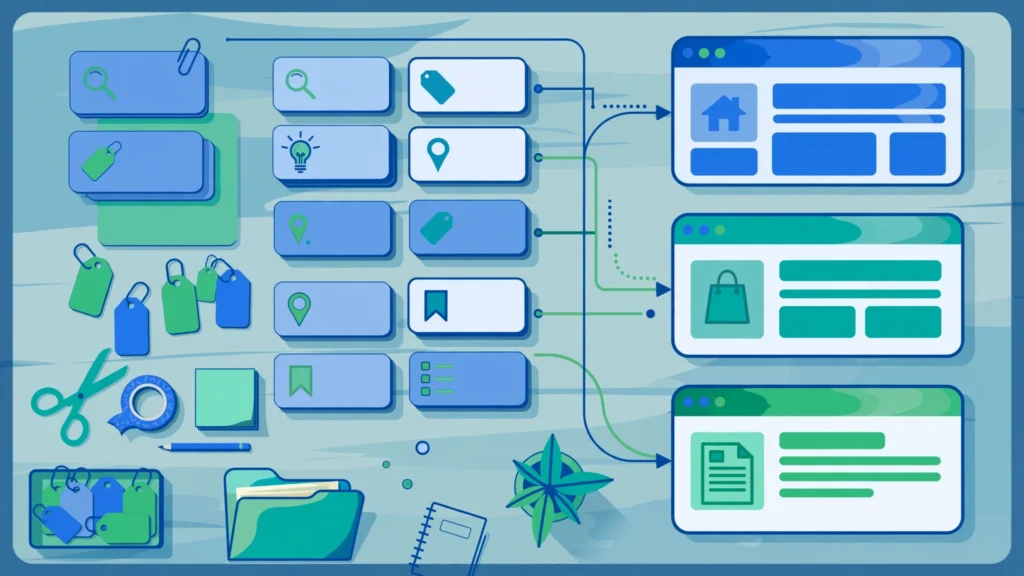
A keyword mapping strategy assigns one primary keyword to one page. Follow the step-by-step process, template, and worked example to stop cannibalization.
How to Improve E-E-A-T: A Practical Checklist for 2026

If you have been searching for how to improve E-E-A-T in 2026, you are asking exactly the right question at exactly the right time. Google’s quality evaluators and its ranking systems both lean harder than ever on Experience, Expertise, Authoritativeness, and Trustworthiness — and now AI answer engines use the same signals to decide which sources they cite. This guide gives you a practical, step-by-step plan for how to improve E-E-A-T, with actions you can start implementing today, whether you run a small business site, a blog, or an agency portfolio. Before we dive in, one important clarification: Google has stated that E-E-A-T is not a single, directly measurable ranking factor. Instead, it describes the qualities its systems are designed to reward. Sites that consistently demonstrate strong E-E-A-T tend to rank better, survive algorithm updates with less damage, and get cited more often in AI-generated answers. So when you learn how to improve E-E-A-T, you are really learning how to make your website demonstrably worth trusting. What E-E-A-T Means in 2026 E-E-A-T stands for Experience, Expertise, Authoritativeness, and Trustworthiness. It comes from Google’s Search Quality Rater Guidelines, the manual human raters use to judge search results. The “E” for Experience was added in 2022, and it reflects a real shift: Google increasingly values content written by people who have actually done the thing they are writing about. A review from someone who used the product, a guide written by a practitioner, a case study with real numbers — these beat generic summaries every time. Trust is the center of gravity. Google treats the other three signals as ingredients that feed into trustworthiness: experience and expertise establish credibility, authority shows that others recognize it, and trustworthiness is what the whole package produces. That hierarchy matters because it tells you where to focus if you want to know how to improve E-E-A-T efficiently: start with the trust signals you can control directly, then build outward into authority. In 2026 the stakes are higher because search is no longer just ten blue links. AI Overviews and other AI answer engines decide which sources to quote based on citation-worthiness, and the filters look remarkably like E-E-A-T: named authors, verifiable credentials, factual density, and third-party mentions. If your site gets cited by AI systems, you win visibility even when users never click through to a traditional result. For more on this shift, see our guide on how to rank in Google AI Overviews. Why Improving E-E-A-T Matters More Than Ever Three forces have made 2026 the year of E-E-A-T. First, the web is flooded with generic AI-generated content, so search engines have to work harder to separate credible sources from content farms. Sites that show real experience and named experts stand out precisely because most content no longer does. Second, YMYL topics — health, finance, legal, safety — face even stricter scrutiny, and inaccurate advice there can cause real harm. Third, as AI search grows, your brand’s off-site reputation (reviews, mentions, citations) becomes visible evidence of trust that machines can measure. The encouraging news is that E-E-A-T rewards substance over scale. A small business with a genuine expert behind it and documented client results can outrank a large brand publishing shallow content. You do not need a massive budget to strengthen these signals — you need consistency, transparency, and proof. That is exactly what this guide to how to improve E-E-A-T delivers. How to Improve E-E-A-T: The 2026 Checklist Work through these seven areas in order. The first ones are quick wins; the later ones compound over months. Every step is something a real visitor — or a quality rater — can verify. 1. Publish Experience-Based, Original Content The single most effective answer to how to improve E-E-A-T is also the simplest: write from real experience. Share case studies with actual numbers, publish original research or tests, include screenshots and photos you took yourself, and describe what you tried, what worked, and what failed. Generic content can be regenerated by any AI model; firsthand experience cannot. If a topic is outside your direct experience, interview someone who has it and quote them by name. Also audit for thin or outdated content. Pruning or refreshing low-quality pages is one of the fastest ways to lift your site’s overall E-E-A-T profile. Update statistics, fix broken links, rewrite shallow posts with real depth, and remove pages that no longer serve a purpose. 2. Put Real Authors With Real Credentials on Every Key Page Every important page should answer three questions a visitor asks instantly: Who wrote this? Why should I trust them? Who is behind this website? Add a full author byline to blog posts with a short bio, photo, and links to professional profiles. Create a dedicated author archive page for each writer that lists their credentials, certifications, and years of experience. This step matters doubly in 2026: AI answer engines use named author credentials as a citation filter. Anonymous content rarely gets quoted. If you work with freelancers, attribute the real writer — and if you use AI-assisted drafting, a human expert must review, fact-check, and sign off before publishing. 3. Build Topical Authority, Not Random Posts Authority in a niche comes from depth, not breadth. Instead of publishing disconnected articles on unrelated topics, build content clusters around a few core themes and interlink them thoroughly. Ten strong, interconnected posts on one subject tell Google you are an authority; ten scattered posts tell it you are a generalist. Map your core topics, identify gaps, and fill them systematically. Internal linking between related pages helps both users and crawlers understand your expertise, and it keeps visitors exploring your site longer — another positive trust signal. 4. Earn Mentions and Links From Reputable Sources When it comes to how to improve E-E-A-T, earning external validation is the second half of the answer. When respected websites link to or mention your content, they are vouching for you. To strengthen this signal, publish link-worthy assets: original studies, free tools,
Zero Click Search Strategy: A 2026 Survival Guide

Your rankings are up. Your impressions are up. Your traffic is down. If that sentence describes your analytics dashboard, you’re living through the zero-click era — and you need a zero click search strategy before the gap gets wider. A zero-click search is any search that ends without the user clicking through to a website. Google answers the question right on the results page — through AI Overviews, featured snippets, knowledge panels, or People Also Ask boxes — and the searcher gets what they need and leaves. Widely-cited research has put the zero-click share of Google searches at roughly 60%, and AI Overviews have only pushed that number higher. This isn’t a reason to abandon SEO. It’s a reason to change what “winning” means. This playbook shows you how to build a zero click search strategy that turns unclicked searches into brand visibility, authority, and eventually customers. What Is a Zero-Click Search? A zero-click search happens when Google satisfies the query directly on the search results page. The user types a question, reads the answer, and never clicks. The main culprits: AI Overviews: Google’s generative summaries at the top of results, with a handful of cited sources. Featured snippets: the classic “position zero” answer box pulled from a ranking page. Knowledge panels: entity information (businesses, people, places) shown in a side panel. People Also Ask (PAA): expandable question boxes that answer follow-up queries inline. Direct answer boxes: instant answers for weather, calculations, definitions, conversions. Here’s the uncomfortable truth most guides bury: zero-click searches are not all bad. A huge share of them were never going to become customers. “what time is it in Tokyo” was never a buying journey. The strategic question is which zero-click queries touch your buyers, and how you show up inside them. How Big Is the Zero-Click Problem in 2026? Let’s put numbers on it. The landmark SparkToro/Datos analysis found that nearly 60% of Google searches in the US and EU ended without a click to the open web — and that was before AI Overviews rolled out broadly. With AI-generated summaries now appearing on a large share of informational queries, the zero-click share for question-type searches is almost certainly higher today. But the aggregate number hides the important split: Navigational and simple informational queries (weather, definitions, quick facts): 70–80%+ zero-click. These were always low-value for most businesses. Commercial investigation queries (“best CRM for small business”, “X vs Y”): still heavily clicked, because buyers want depth, comparisons, and proof before deciding. Local queries: often “zero-click” in the technical sense — the user calls, gets directions, or books straight from the business profile without visiting the website. That’s a conversion, not a loss. Your zero click search strategy should start by segmenting your own Search Console data: which queries lost clicks while gaining impressions? Those are your zero-click battlegrounds. Everything else is noise. Why Your Zero Click Search Strategy Can’t Just Be “Rank Higher” The old instinct — “we’ll just rank #1 and the clicks will come” — breaks down in a zero-click SERP. When an AI Overview answers the question above the fold, the #1 organic listing sits below it. Studies of AI Overview SERPs consistently show depressed click-through rates for the traditional listings underneath. Ranking still matters enormously — AI Overviews disproportionately cite pages that already rank well. So rankings are the ticket to the citation game. But ranking is now necessary rather than sufficient. A complete zero click search strategy optimizes for the whole SERP surface, not just the blue links: Win the featured snippet and PAA boxes for your question set. Get cited inside AI Overviews (see our AI Overviews ranking playbook for the exact structure). Own your knowledge panel and entity presence. Make your brand the memorable name inside answers people read but don’t click. The goal shifts from “earn the click” to “become the answer.” When you become the answer, the clicks that do happen convert better — because the searcher already trusts the source. The 6 Pillars of a Winning Zero Click Search Strategy 1. Map every question, not just every keyword Traditional keyword research targets the words people type. Zero-click optimization targets the intent behind those words. For each priority topic, map 30–50 real questions using Google’s People Also Ask, autocomplete, and the questions AI chatbots answer in your niche. These questions are the content brief for your zero click search strategy — each one is a potential PAA win, snippet win, or AI citation. 2. Write answer-first, every time The single highest-leverage format change: put a direct 40–60 word answer immediately under each question-style heading, then elaborate below. This gives Google a clean extraction point for snippets and PAA boxes while keeping enough depth to earn the click from users who want more. Question as H2, direct answer as the first paragraph, supporting detail after — no filler intros. This discipline is the foundation of a strong zero click search strategy. 3. Structure for extraction AI systems and snippet algorithms both prefer content that’s easy to lift. Use ordered lists for processes, tables for comparisons, and short declarative paragraphs for definitions. Add schema markup (FAQ, HowTo, Article) that accurately reflects visible content — Google’s structured data documentation is the authoritative reference for what’s supported. Structured data doesn’t guarantee selection, but it removes friction from your zero click search strategy. 4. Build entity authority Knowledge panels and AI answers both run on entities, not keywords. Keep your business name, description, and category identical across your site, Google Business Profile, LinkedIn, and directories. Publish original data and expert quotes that third parties reference — corroboration across sources is what makes an AI system confident enough to cite you, a key input to any zero click search strategy. 5. Diversify beyond the blue links With organic clicks under pressure, the channels that capture demand directly matter more: email lists, YouTube, podcasts, industry communities, and direct brand search. A searcher who reads your cited answer today and searches your brand name