Google increasingly rewards sites that demonstrate deep, connected coverage of a subject — the go-to source for a topic, not a random page that matches a keyword. This guide shows you how to build topical authority step by step: the honest definition, a 7-step system, a self-audit score, and how to measure it. No filler, no fake scores.
What Topical Authority Really Means (Start With the Honest Version)
Topical authority is the degree to which your site is recognized — by readers, peers, and search systems — as a consistently valuable, trustworthy source on a defined subject. The signs: deep coverage, original contributions, consistent focus, clear page relationships, positive reputation, and evidence people return to or cite your work.
Here is the honesty part. Anyone teaching how to build topical authority should start with this: Google has never published a universal “topical authority score” the way Moz publishes Domain Authority. Google has documented a “topic authority” system for newsy queries — surfacing expert sources using signals like notability and original reporting — but that does not prove publishing 25 cluster pages triggers an identical site-wide mechanism for every blog.
So treat “topical authority” as a practitioner framework, not a confirmed single ranking factor — per Google’s ranking-systems guidance, its systems work mainly at page level with some site-wide signals. The smart move: build topic depth as a consequence of serving your audience well, not as theater for an imagined score.
Why Topical Depth Now Beats Raw Domain Authority
The March 2026 core update changed the math for smaller sites: the winners shared one trait — narrow, deep topical coverage beat bloated domains stretching to rank for everything.
The cautionary tale is just as clear. Generalist publishers that coasted on domain authority to rank for off-topic content got cut down hard — the widely reported traffic collapse of a major marketing publisher after years of “publish anything that ranks” is the textbook example.
For a focused business, this is the best news in a decade. You no longer need to out-link a 500,000-page competitor — you need to know more about your specific topic and prove it. A regional plumber can now outrank a national media giant on a niche query because the plumber has the depth. That is the environment this playbook is built for. For a focused business, learning how to build topical authority is now the highest-leverage SEO investment available.
How to Build Topical Authority: The 7-Step System
Every site that has cracked how to build topical authority in 2026 uses some version of the same architecture. Here is the complete system, in the order that compounds.
Step 1: Draw Your Topic Boundary
The first decision when learning how to build topical authority is also the hardest: choosing what not to cover. A defensible topic sits where three circles overlap — audience demand, credible contribution, and strategic relevance.
Write a one-sentence boundary statement: “We cover [subject] for [audience] so they can [outcome]. We do not cover [adjacent subjects] unless they change that outcome.” Topic discipline is the foundation everything else rests on.
Step 2: Map Reader Jobs, Not Keyword Permutations
List the decisions people make inside your topic in a spreadsheet, organized by job family: Understand, Choose, Plan, Implement, Troubleshoot, Measure, Maintain. Pull questions from People Also Ask, autocomplete, forums, and your inbox — customers ask things no tool shows you. Each distinct job becomes a candidate page; smaller questions become sections. This six-month editorial calendar is the engine of how to build topical authority.

Step 3: Give Every URL Exactly One Job
Before writing anything, assign each reader job to one URL and write a one-sentence responsibility for it: “This page is the site’s best answer for [reader] who needs to [job]; it does not own [neighboring job].” If two proposed pages cannot be distinguished without mentioning their target keywords, they are the same page. Merge them now.
This prevents topical cannibalization: two of your own pages competing for one query split your relevance signals, so neither ranks as well as one complete page would. One job, one URL, no exceptions. Cannibalization is the most common reason teams stall when learning how to build topical authority — the repair playbook is covered later.
Step 4: Publish the Pillar First, Then Clusters in Demand Order
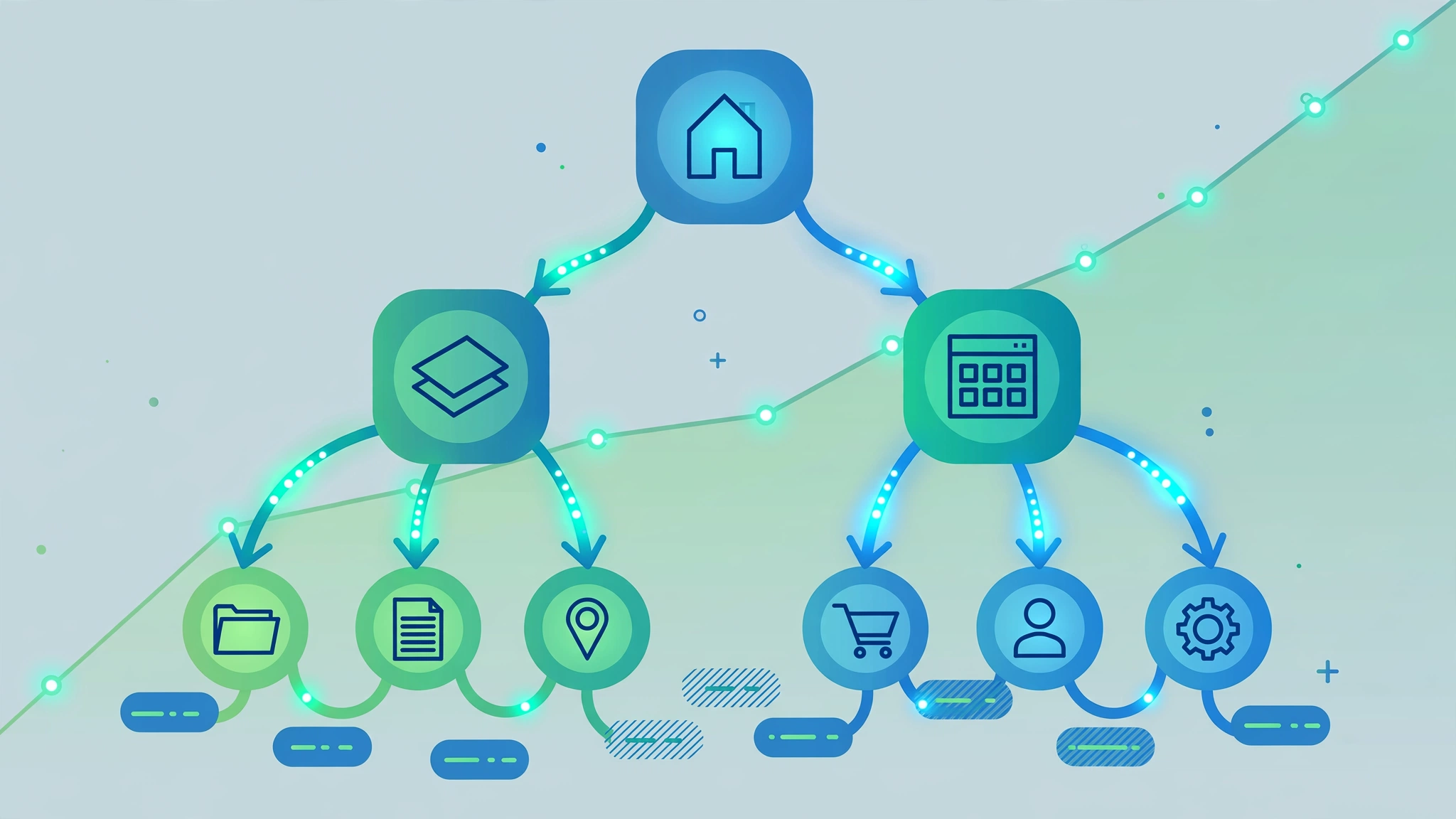
Your pillar page is the backbone of how to build topical authority that lasts: a 2,500–3,500-word resource covering the core topic broadly, answering the main question in the first hundred words, and linking to every supporting page. It should rank for the head term, and it is your most linkable asset.
Then publish supporting pages in demand order — highest-demand subtopics first, so the cluster earns traffic while it grows. Each cluster page covers one subtopic thoroughly (1,200–2,000 words), links back to the pillar, and sideways to its closest siblings. A subtopic that cannot support 800 honest words is a section, not a page. Thin filler weakens the cluster.
Step 5: Wire Internal Links Like Architecture, Not Decoration
Internal links are the wiring diagram for how to build topical authority — how you tell Google “these pages are one body of expertise.” Most sites fail two ways: linking to the homepage instead of related posts, and dropping context-free links in the conclusion.
The rules: every cluster page links to its pillar at least twice, with descriptive anchor text containing the pillar’s primary keyword. Place links inside the section that earned the citation — context around the link is what passes relevance. The pillar links down to every cluster; siblings link where one supplies the next decision. Sketch the map from memory before publishing. If you cannot sketch it, your plan for how to build topical authority is not finished yet.
Step 6: Earn Depth With Information Gain
A complete cluster is not the one with the most URLs. It is the one where every page contributes something beyond a competent summary: first-hand observation, original data, a worked example, a decision framework, a downloadable template, or the failure modes competitors omit.
This is also where author credibility compounds. Real bylines, real bios, and visible publication and review dates make authority claims inspectable. That is how to build topical authority that survives both algorithm updates and AI search shifts. Never invent credentials or imply results you cannot disclose — trust is the load-bearing wall of the whole system. As AI search grows, this matters doubly: AI Overviews pull citations from across the cluster of pages that demonstrate authority on a topic, not just the top-ranking page.
Step 7: Distribute, Then Maintain Like an Asset
Authority is not created entirely on your own domain. Promote your strongest pages where their audience participates — communities, newsletters, podcasts. Useful work earns editorial links, mentions, repeat visitors, and branded searches, and each feeds back into the signals that matter.
Then maintain the cluster like the asset it is. Anyone who has learned how to build topical authority knows the maintenance phase is where most competitors drop off. Give every page an owner and reopen it when: an official source changes, search intent shifts, a product is retired, impressions rise while CTR stays flat, queries expose missing subproblems, two URLs compete for one job, links break, or the review interval expires.
The Coverage-Quality Score: Audit Your Cluster This Week
Forget vanity metrics. If you are serious about how to build topical authority, you need an internal score — here is a practical one you can run on a spreadsheet in an afternoon. For each important reader job in your topic, score 0 to 3 on eight dimensions:
| Dimension | 0 (missing) | 3 (strong) |
|---|---|---|
| Demand evidence | No proof anyone searches this | PAA, forums, and Search Console data confirm it |
| Distinct URL responsibility | Two pages fight for this job | One URL owns it completely |
| Answer completeness | Thin summary | The job is finished on this page |
| Original contribution | Rewritten competitors | Data, template, or framework of your own |
| Source strength | No citations | Primary sources, checked dates |
| Internal relationships | Orphaned page | Links up, down, and sideways with context |
| Maintenance ownership | Nobody owns it | Owner + review trigger assigned |
| Demonstrated reader value | No engagement | Repeat visits, citations, conversions |
Jobs scoring under 12 out of 24 are your priority queue: fix, merge, or retire them before adding new pages. This is an internal planning tool, not a Google metric. Its value is revealing whether your “coverage” is a maintained asset or just a published URL.
How to Detect and Fix Topical Cannibalization
Cannibalization — two of your own pages targeting the same query — is the silent killer of how to build topical authority: it looks like “more content” while behaving like sabotage. Detect it with three checks:
- Search Console overlap: two URLs from your site ranking for the same query, with positions that bounce around between them.
- The site: test: search site:yoursite.com “target keyword” and see if two pages could each plausibly be the answer.
- The responsibility test: if you cannot write distinct one-sentence responsibilities for both pages, they are cannibalizing.
| Situation | Fix |
|---|---|
| Two thin pages, same job | Merge into one complete page; 301 redirect the weaker to the stronger |
| One strong page, one weak duplicate | Fold the weak page’s unique points into the strong one; redirect |
| Same keyword, different intent (guide vs. tool) | Keep both, but differentiate titles, intros, and internal links so intent is unambiguous |
| Old post contradicts new post | Update the old post with a correction note, or retire and redirect it |
After any merge, update internal links that pointed to the retired URL. One job, one URL — the rule from Step 3 is also the repair rule.
How to Measure Topical Authority in Search Console
You cannot buy a topical authority score, but you can measure whether your program for how to build topical authority is working by tracking the cluster as a portfolio in Google Search Console:
- Query breadth: total distinct queries the cluster’s pages appear for — this should grow steadily as coverage deepens.
- Impression trend: total impressions across all cluster URLs, compared against a baseline from before the push.
- Position-band movement: how many valuable queries moved into positions 1–3, 4–10, and 11–20. Authority shows up as a migration upward, not one viral page.
- Pages earning visibility: the count of cluster pages with meaningful impressions. If three pages carry the whole cluster, your coverage has gaps.
- CTR in context: impressions rising while CTR stays flat means titles and snippets need work — or intent shifted under you.
Layer in off-Google signals: editorial links, mentions, repeat visitors, branded searches, and qualified inquiries. Compare against a documented baseline, and resist attributing every change to authority — demand, competition, and technical conditions move too.
How to Build Topical Authority in 90 Days
- Days 1–15: write the boundary statement, list reader jobs, inventory existing content, and gather proof assets (data, screenshots, templates).
- Days 16–30: map keywords and intent to URLs, merge cannibalizing pages, and select the minimum viable cluster.
- Days 31–45: publish the pillar page and produce research-first briefs for the first cluster articles.
- Days 46–70: publish supporting pages in demand order — two to three per week — with internal links wired as you go.
- Days 71–80: distribute the strongest assets where their audience participates; add contextual links from established pages.
- Days 81–90: verify indexation, run the coverage-quality score, fix gaps, and schedule review triggers.
Expect the first month of any how to build topical authority push to feel like nothing is happening — Google needs to recrawl and re-evaluate site-level signals. Most sites see meaningful lift three to six months in. The discipline is not output volume; it is staying inside one topic.
What Does Not Build Topical Authority
Clear the field before you start. These traps waste the most effort for teams trying how to build topical authority: one page per keyword variant; entering a niche just for search volume; summarizing top-ranking pages without adding value; dozens of thin AI pages called a cluster; fake authors, credentials, or case studies; indiscriminate cross-linking; changing dates without real review; treating third-party metrics as Google trust; and ignoring old, contradictory, or cannibalizing content. Every one is activity disguised as strategy.
FAQs
How long does it take to build topical authority?
Most sites see meaningful lift three to six months after their cluster reaches critical mass — roughly 25 tightly-connected articles for a typical subject, though narrow topics need fewer. The first month will feel like nothing is happening while Google recrawls. Resist scrapping the strategy at week three; authority compounds slowly.
Can a small or new website build topical authority and outrank big competitors?
Yes, on a narrow topic. A smaller site builds recognizable expertise faster by being more focused, useful, original, and consistent than a generalist giant. That does not guarantee outranking established sites everywhere, but post-2026 rankings reward depth over domain-wide breadth. Pick a lane you can own and cover it completely.
Do I need backlinks if I have topical authority?
Backlinks still help, especially to your pillar page, where they push authority down to clusters. But backlinks alone no longer compensate for shallow content — and strong topical authority can increasingly compensate for a thin backlink profile. If you must choose one first, build the authority; links to a weak cluster convert poorly.
How many articles do I need to build topical authority?
There is no fixed number. Cover the important, distinct reader jobs at credible depth and maintain them — that is how to build topical authority without filler. A five-page cluster can be complete for a narrow subject; fifty pages can remain shallow for a complex one. Add pages only when research identifies a distinct job worth the maintenance cost.
Is topical authority a confirmed Google ranking factor?
Not as a single universal factor. Google documents a topic-authority system for certain newsy queries, and its ranking-systems guidance mentions page-level plus some site-wide signals. The broader concept is a practitioner framework describing how deep, connected, trustworthy coverage behaves in search. Use it as strategy, not a promised lever.
Does AI-generated content hurt topical authority?
The production method alone is not the issue. Google’s scaled-content policies target pages generated mainly to manipulate rankings that add little value, however produced. AI-assisted work still needs original value, accuracy, accountability, sourcing, and editorial judgment. Generic AI summaries are infinite and free — original contribution separates an authoritative page from filler. If your content pipeline needs an AI-crawler strategy too, build it on the same foundation of real expertise.
That is how to build topical authority the way that survives updates. If you want this system applied to your own site — a topic boundary, a mapped cluster, and a pillar wired for both Google and AI search — get a free site audit from SSA Agency and we will show you exactly where your coverage stands.