Links connect pages across the internet. They help people find useful content and allow search engines to discover new pages.
In SEO, you may hear terms such as inbound links, backlinks, outbound links, and internal links. These terms sound similar, but they have different meanings.
So, what are inbound links?
An inbound link is a link from another website to your website. It is also commonly called a backlink.
Inbound links can bring visitors to your site. They can also help search engines discover your content. Let’s look at how they work and why they matter.
What Are Inbound Links?
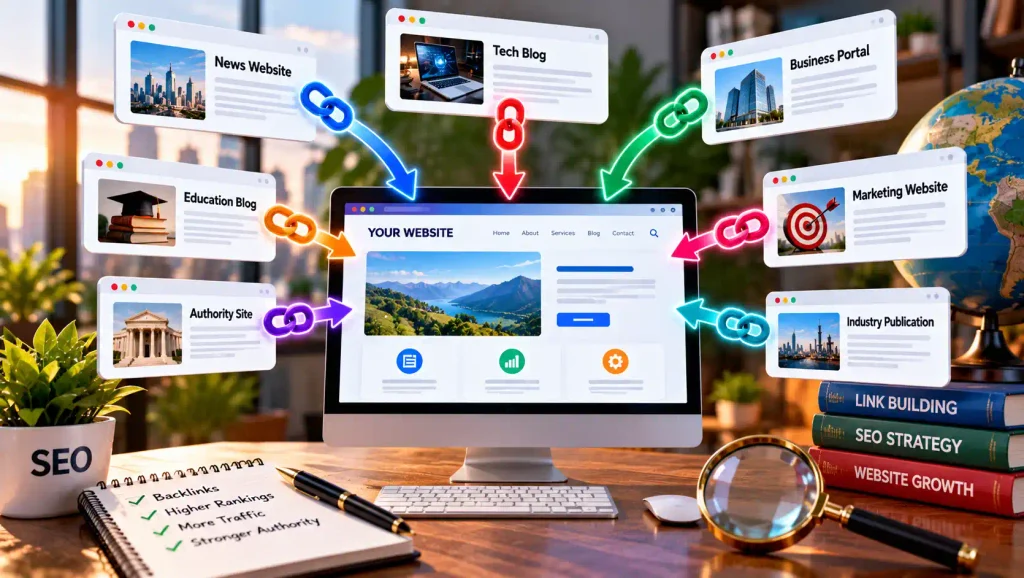
An inbound link is a hyperlink from another website that points to your website.
For example, a marketing blog may publish an SEO article and link to one of your guides.
The link would look like this:
Other Website → Your Website
Your website has received an inbound link.
Inbound links are also called:
- Backlinks
- Incoming links
- External inbound links
- Links from referring websites
The same link is an outbound link for the website that created it.
Why Are Inbound Links Important?
Inbound links can help your website in several ways.
First, they help people discover your content. Someone reading another website may click a link and visit your page.
Second, inbound links can generate referral traffic. A link from a relevant website can send interested visitors directly to your content.
Third, links help search engines discover pages across the web.
Inbound links can therefore support an off-page SEO strategy.
However, more links do not always mean better results. Quality and relevance matter more than simply collecting backlinks.
What Makes a Good Inbound Link?
A good inbound link should make sense to the reader.
For example, a link from a marketing website to an SEO guide has a clear connection.
When checking a backlink, consider:
- Website relevance
- Content quality
- Link placement
- Anchor text
- Website reputation
- Referral traffic potential
A natural link inside useful content can be more valuable than many unrelated links.
What Is Anchor Text?
Anchor text is the clickable part of a link.
For example:
Read our guide about technical SEO.
Here, “technical SEO” is the anchor text.
Good anchor text helps readers understand what they will find after clicking.
Keep it natural. Using the same keyword again and again can make a backlink profile look unnatural.
Inbound Links vs. Internal Links
Inbound and internal links are different.
An inbound link comes from another website:
Other Website → Your Website
An internal link connects pages on your own website:
Your Page A → Your Page B
Internal links help users find related content. They also help search engines understand your website structure.
Both types of links are useful for SEO.
Inbound Links vs. Outbound Links
The main difference is direction.
An inbound link points from another website to your site.
An outbound link starts on your website and points to another site.
For example:
Another Website → Your Website = Inbound Link
Your Website → Another Website = Outbound Link
Outbound links are often used to provide sources, research, tools, or extra information.
What Is Link Building?
Link building is the process of earning or getting links from other websites.
Common link-building methods include:
- Creating useful content
- Guest posting
- Digital PR
- Broken link building
- Resource link building
- Industry outreach
Good link building focuses on quality and relevance.
For example, a detailed study may earn links because other writers want to use its information as a source.
The goal should not be to collect as many links as possible.
What Type of Links Are Best for SEO?
There is no single backlink that is best for every website.
In general, useful backlinks come from relevant and trustworthy websites.
A strong link may have:
- Relevant content
- Natural placement
- Useful anchor text
- A trusted referring website
- Real value for readers
- Referral traffic potential
SEO metrics such as Domain Authority or Domain Rating can help with research. However, you should not use these scores alone to judge a link.
Always look at the actual website and its content.
Can Inbound Links Increase Traffic?
Yes. Inbound links can bring referral traffic.
Imagine a popular industry website links to your guide. Some readers may click that link because they want more information.
Those visitors then arrive on your website.
This traffic can be useful because the visitors are already interested in a related topic.
A backlink can therefore provide value even beyond search rankings.
What Is Inbound Marketing?
Inbound marketing is a strategy used to attract potential customers with useful content.
Examples include:
- Blog posts
- SEO content
- Videos
- Helpful guides
- Case studies
- Webinars
- Email newsletters
The goal is to answer questions and help people solve problems.
For example, a company may publish a useful guide that appears in search results. People find the guide, visit the website, and learn more about the company.
What Is Outbound Marketing?
Outbound marketing takes a different approach.
Instead of waiting for people to discover content, a business sends promotional messages to an audience.
Examples include:
- Cold calling
- Direct mail
- TV advertising
- Radio advertising
- Display advertising
Inbound marketing focuses on attracting people through useful content.
Outbound marketing focuses more on reaching people with promotional messages.
Inbound Links vs. Inbound Marketing
These terms use the same word, but they mean different things.
An inbound link is a link from another website to your website.
Inbound marketing is a strategy for attracting customers through useful content and experiences.
They can still work together.
For example, a helpful blog article may be part of an inbound marketing strategy. Other websites may then link to that article, creating inbound links.
Common Inbound Link Mistakes
Avoid focusing only on backlink numbers.
Other common mistakes include:
- Getting links from unrelated websites
- Using spammy link-building methods
- Repeating exact-match anchor text
- Ignoring website quality
- Building links only for rankings
- Ignoring referral traffic
- Using manipulative link schemes
A better approach is to focus on links that make sense for real users.
Frequently Asked Questions
What Type of Links Are Best for SEO?
Relevant and naturally placed links from trustworthy websites can be useful for SEO. Look at the quality of the website, content relevance, anchor text, and value for readers.
What Is the Difference Between Inbound and Outbound Links?
An inbound link comes from another website to your website. An outbound link goes from your website to another website.
What Is an Example of Inbound Marketing?
A helpful blog post that answers a customer’s question is a simple example. SEO articles, videos, guides, webinars, and newsletters are other examples.
What Is Inbound vs Outbound?
Inbound marketing attracts people through useful content. Outbound marketing reaches people through promotional messages.
For links, inbound means a link coming to your website. Outbound means a link going from your website to another site.
Final Thoughts
Inbound links are links from other websites that point to your website. They are also commonly known as backlinks.
They can help people discover your content, bring referral traffic, and support your SEO strategy.
However, do not focus only on getting more links.
Look for relevant websites, useful content, natural anchor text, and links that provide real value to readers.
Understanding inbound, outbound, and internal links will also make it easier to build a clear website and a stronger long-term link-building strategy.