Most websites do not have a content problem. They have an organization problem. Hundreds of disconnected blog posts sit on the same domain, each targeting a keyword in isolation, none of them reinforcing the others. Google sees a pile of pages. It does not see authority. Learning how to create pillar pages and topic clusters matters more in 2026 than ever: search engines now reward sites that demonstrate topical depth, not just keyword relevance.
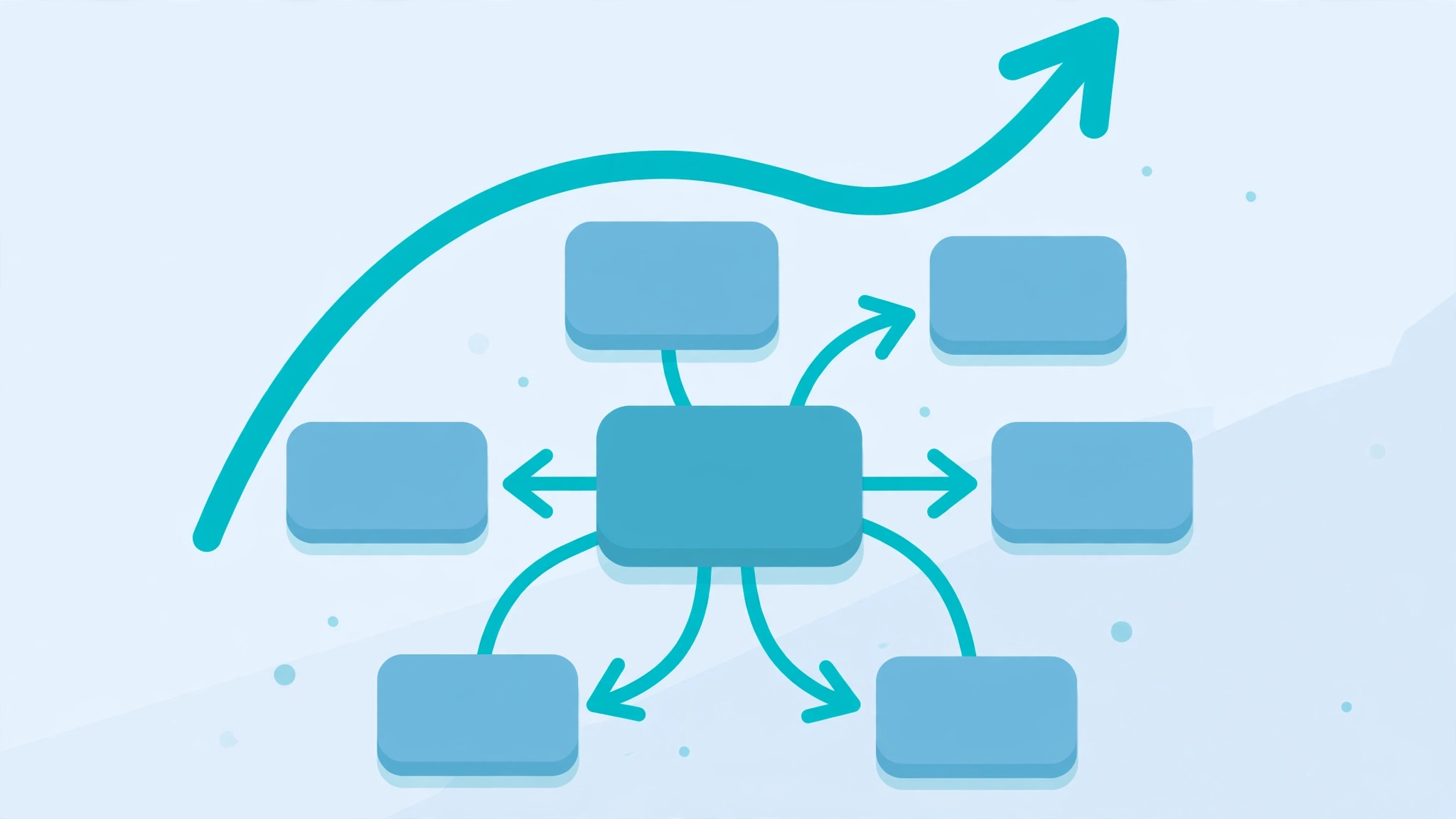
A pillar page is a comprehensive, long-form resource that covers a broad topic at the hub level. Topic clusters are the supporting articles — the spokes — that each go deep on one specific subtopic and link back to the pillar. Together they form a visible web of expertise that helps users explore a subject and helps Google understand that your site owns it. Clustered content has been shown to drive roughly 30% more organic traffic than standalone posts.
This guide walks you through the complete process of creating pillar pages and topic clusters: choosing pillar topics, mapping clusters, making the URL architecture decision most guides skip, building the pillar and spokes, wiring the internal links, and keeping the whole thing healthy over time.
What Pillar Pages and Topic Clusters Actually Are
Before building, get the definitions right, because three confusions derail most projects:
- Pillar page vs. cluster page: the pillar is the hub — broad, evergreen, and educational. A cluster page (also called a spoke) is one deep dive into a single subtopic. The pillar defines the topic ecosystem; cluster pages expand it.
- Pillar page vs. landing page: not the same thing. A landing page is conversion-focused and often campaign-specific, with minimal navigation. A pillar page is informational, designed for organic discovery, and optimized for topical coverage. A pillar may include calls to action, but conversion is not its primary job.
- Topic cluster vs. content silo: silos are rigid, walled-off site sections. Topic clusters are flexible and networked — spokes can link laterally to related spokes, and clusters can overlap when it serves the reader.
The reason this structure works comes down to how modern search engines evaluate authority. They look for signals of depth: one topic, many high-quality answers, clear semantic relationships. A cluster sends exactly that signal, while also improving crawl efficiency and reducing bounce by guiding visitors from one answer to the next.
Step 1: Choose Pillar Topics That Deserve the Investment
Not every topic earns a pillar. Building one is a commitment of dozens of pages, so filter candidates through three lenses:
- Business relevance. The pillar should map to a service or product area you must rank for to grow revenue. If you are an SEO agency, “SEO” itself, “technical SEO,” and “local SEO” are natural pillars. Pick topics you can legitimately become the expert on.
- Search demand. The topic needs enough query volume and subtopic breadth to justify 8–20 supporting articles. Use keyword tools, Google autocomplete, and People Also Ask boxes to confirm the subtopic supply before committing.
- Realistic winnability. Most sites should start with 3–5 pillars — the ones where relevance is highest and competition is weakest — and widen outward as authority compounds.
A strong starting move: audit your existing content first. Pages that already have traffic, backlinks, or impressions are often the best pillar candidates, because they already carry some authority and links. Teams that invest in pillar pages and topic clusters early tend to compound their topical authority faster, because every new spoke reinforces the pillar. For the foundational industry reference on this strategy, see Search Engine Land’s complete guide to topic clusters.
Step 2: Map Your Clusters Before You Write a Word
Do not start by writing. Start by mapping, because retrofitting internal links onto content published in random order is far more work than planning the structure up front.
For each pillar, harvest 8–12 spoke topics that cover distinct search intents. Pull from People Also Ask boxes, autocomplete, competitor tables of contents, and your sales team’s FAQ list.

Build the map in a spreadsheet with one row per URL and columns for pillar, target keyword, search intent, content format, and the internal links each page must give and receive. This sheet becomes your build checklist and, later, your audit reference. A clean map separates a site that wins with pillar pages and topic clusters from a folder of loosely related posts — and it makes writing faster, because each brief already knows what it links to.
Then run the intent deduplication test: if two proposed cluster pages would satisfy the same query, merge them. This is the single highest-leverage quality check in the whole process, and it is where most DIY clusters fail. Which leads directly to a topic nobody covers — the cannibalization audit in step 6.
Step 3: Make the URL Architecture Decision Nobody Talks About
Here is the gap in nearly every pillar-page guide online: they tell you what to write, but not where to put it. You have two real choices, and each has consequences.
Option A: hierarchical URLs. The pillar lives at /topic/ and clusters live underneath, like /topic/subtopic-guide/. This keeps the cluster relationship obvious in the URL itself and keeps breadcrumbs clean. The trade-off: if you later split or merge clusters, URL changes and redirects follow.
Option B: flat URLs. Everything lives at the root, like /subtopic-guide/, and the cluster relationship exists only in the linking. This is flexible — spokes can belong to multiple clusters without URL awkwardness — but it leans entirely on internal links to communicate structure to Google.
| Factor | Hierarchical (/topic/spoke/) | Flat (/spoke/) |
|---|---|---|
| Semantic clarity in URL | Strong | None — linking does the work |
| Restructuring cost | Higher (redirects) | Lower |
| Cross-cluster spokes | Awkward | Natural |
| Best for | Established, stable topics | New or evolving topics |
The practical rule: use hierarchical URLs for mature topics where the cluster shape is stable, and flat URLs when you are still discovering what the cluster should become. Whichever you choose, apply it consistently — mixed architectures inside one cluster dilute the very clarity you are building. The entire premise of pillar pages and topic clusters is architectural clarity, so commit to one convention per cluster.
Step 4: Build the Pillar Page
The pillar page is a comprehensive summary, not a content dump. It should cover the topic in broad strokes, give the reader a complete mental model, and hand off depth to the spokes. Aim for a structure like this:
- H1 targeting the broad pillar keyword.
- An introduction that defines the topic and states who the guide is for.
- H2 sections — one per spoke topic — each summarizing that subtopic in 150–300 words and linking to the full cluster article with descriptive anchor text.
- Original insight or data where you can earn it: a small study, a framework, or a worked example. This is what earns the backlinks that lift the whole cluster.
- A visible table of contents with anchor links.
Place the pillar at a prominent, crawlable URL — many teams pin pillars in the main navigation or in a visible resources section. Give it schema markup (Article, plus FAQ where appropriate) and show real author credentials on the page, where expertise signals matter most. Since pillar pages and topic clusters are evergreen by design, schedule the pillar for quarterly review rather than treating it as a one-time launch.
Step 5: Publish the Spokes and Wire the Links
Each cluster page targets one long-tail keyword and one intent, goes genuinely deep, and links back to the pillar with descriptive anchor text. Two-way linking — pillar to spoke and spoke to pillar — is the baseline. The structure most teams underuse is lateral linking: spokes linking to related spokes. Google’s own guidance on structuring sites for search reinforces the same principle: clear hierarchies help crawlers understand the relationships between your pages.
Consider the publishing order too. A legitimate strategy is to build the spokes first: cluster pages targeting long-tail queries often rank faster than a broad pillar, and you can attach the pillar afterward once the spokes have traction. Alternatively, publish pillar plus spokes together as a complete package. Either way, add the reciprocal pillar-to-spoke links within the first paragraphs of the pillar, not buried at the bottom.
On anchor text, engineer it deliberately: vary your anchors across the cluster and keep exact-match anchors to a modest share. Repetitive identical anchors across dozens of internal links is the fastest way to make a clean cluster look manufactured. That disciplined, two-way linking is what makes pillar pages and topic clusters so effective at distributing crawl budget and authority.
Step 6: Run the Spoke Cannibalization Audit
This is the maintenance step nobody writes about, and it is where mature clusters quietly bleed performance. Two spokes can drift into the same territory over time — one gets updated, another gets rewritten, and suddenly both target overlapping queries. The result is keyword cannibalization: your own pages split ranking signals and neither ranks well.
Run this audit quarterly on every live cluster:
- Search Console overlap test. For each spoke, pull its top queries. If two spokes share the same high-impression queries, flag the pair.
- The site: test. Search
site:yourdomain.com "query"and see which of your pages Google considers most relevant. If the wrong spoke surfaces, your signals are tangled. - Decide per pair: merge (combine into one stronger page with a redirect), differentiate (sharpen each page’s intent and rewrite overlapping sections), or demote (strip the weaker page’s targeting and let it serve as support).
The intent-dedup test from step 2 exists to prevent this at the planning stage, but clusters are living structures — audits keep your pillar pages and topic clusters honest.
Step 7: Structure Your Pillar Pages and Topic Clusters for AI Search Citations
The newest reason to build clusters well: AI answers cite structured, authoritative content. Google’s AI Overviews, ChatGPT, and Perplexity select sources they can attribute and quote. Clustered content — comprehensive, clearly organized, with attributable authorship — is significantly more likely to be cited than isolated posts.
To make your pillars citation-friendly in the AI era:
- Write each H2 section as a self-contained answer block: a question-style heading followed by a direct answer in the first 40–60 words, then supporting detail. These blocks are exactly the units AI systems extract.
- Keep facts, statistics, and definitions near the headings that introduce them, so extraction tools do not misattribute them.
- Show author credentials and publish dates prominently — AI systems weight attributable, fresh expertise.
- Coordinate the cluster with your llms.txt policy so AI crawlers can discover and parse your best content cleanly.
This angle connects directly to the broader shift in search: read our guide on ranking in Google AI Overviews to see how pillar structure feeds AI visibility across your whole site.
Step 8: Know When to Split a Pillar
Clusters grow. A healthy pillar attracts new spokes, and eventually the pillar page itself becomes unwieldy — 6,000 words with forty outbound links is no longer a useful hub. That is the signal for pillar splitting: promote the strongest spoke into its own pillar, move a subset of related spokes under it, and turn the original pillar into a higher-level overview.
Watch for the triggers: the pillar keeps climbing past 5,000 words, new spokes form a coherent sub-theme of 6+ articles, or Search Console shows the pillar ranking for two distinct query families. When you split, update all affected internal links, redirect the old spoke URL if it moves, and refresh the original pillar’s summary sections. Handled well, pillar pages and topic clusters scale naturally into a full topic portfolio instead of a single oversized guide.
Step 9: Measure and Maintain the Cluster
A cluster is a program, not a project. Track cluster-level KPIs rather than judging pages in isolation:
- Keyword breadth: how many distinct queries the whole cluster ranks for, and how that count trends over time.
- Internal link engagement: click-through from pillar to spokes and between spokes — the behavioral proof the structure works for humans, not just crawlers.
- Answer inclusion rate: how often cluster pages appear in AI Overviews or featured snippets for their target queries.
- Conversion lift: assisted conversions from cluster traffic, since pillars often serve awareness-stage visitors who convert later.
Maintain a refresh cadence: revisit the pillar quarterly to add new spoke summaries and expand the FAQ. Refresh spokes when their data decays or when Search Console shows impression growth stalling. The compounding gains of maintained pillar pages and topic clusters — visibility, citations, and conversions — become measurable within months, not years.
FAQs
What is the difference between a pillar page and a cluster page?
A pillar page is the broad hub that summarizes an entire topic, while a cluster page (spoke) dives deep into one specific subtopic. The pillar links out to all cluster pages, and each cluster page links back to the pillar. Think hub versus spoke: the pillar defines the ecosystem, and the clusters expand it with detailed, intent-specific content. That hub-and-spoke relationship is the core architecture of pillar pages and topic clusters.
How many cluster articles should a pillar page have?
Most effective pillars support 8 to 12 cluster articles. Fewer than 5 spokes rarely justifies a pillar, and more than 20 usually means you should split into two. Start with the 8 highest-value intents, publish those, then expand based on Search Console data.
Should a pillar page be a blog post or a static page?
Either works, but static pages (service or resource pages) tend to suit pillars better: they are evergreen, easy to feature in navigation, and accumulate links over time. Blog posts work fine too, especially for publishing-news-style topics. Choose the format your CMS and navigation support most prominently.
How long does it take for topic clusters to improve rankings?
Expect early movement in 4 to 12 weeks on an established domain as spokes get indexed and internal links take effect, with compounding gains over 3 to 6 months. New domains take longer — topical authority is a program, not a one-time launch.
Can a cluster page rank before the pillar page?
Yes, and this is common. Cluster pages target specific long-tail queries with lower competition, so they often rank first — many teams deliberately publish spokes before the pillar. Once the pillar goes live and reciprocal links are in place, it typically rises for the broader head term, lifted by the authority of its spokes.
Do pillar pages still work with AI search and AI Overviews?
They work better than ever. AI answer engines prefer comprehensive, well-structured, attributable content — exactly what a good pillar provides. Structuring pillar sections as self-contained answer blocks, showing author credentials, and coordinating with llms.txt makes cluster content significantly more likely to be cited in AI-generated answers.
Knowing how to create pillar pages and topic clusters replaces scattered keyword chasing with intentional, connected content designed to satisfy entire user journeys. Start with a short audit, pick three to five priority pillars, and map before you write. If you want an expert pair of eyes on your cluster architecture, get a free site audit from SSA Agency — we will map your pillar opportunities and find the gaps your competitors are missing.