If you have ever searched for something on Google, you may have wondered why some websites appear at the top while others are much lower down. There are many reasons for this, but one important factor is SEO.
So, what is SEO?
SEO stands for search engine optimization. It is the process of improving a website so people can find it more easily through search engines such as Google and Bing. The main goal is to help search engines understand your pages while also giving visitors useful and easy-to-read information.
Good SEO is not about repeating keywords again and again. It is about creating a helpful website, answering real questions, improving the user experience, and making your pages easy for search engines to discover.
When done properly, search engine optimization can increase organic traffic and help a website reach people who are already searching for its products, services, or information.
https://ssaagency.us/free-audit/
How Does SEO Work?
Search engines have a huge amount of information to organize. When someone searches on Google, the search engine tries to provide useful and relevant pages for that query.
The process can be understood in three basic steps: crawling, indexing, and ranking.
First, search engine crawlers discover pages on the internet. They follow links from one page to another and collect information about those pages.
Next comes indexing. Search engines study the pages they discover and may add suitable pages to their index. In simple terms, an index works like a huge digital library.
Finally, when someone performs a Google search, the search engine looks through its index for pages that may answer the query. It then decides how those pages should appear in the search engine results pages.
This is why an optimized website needs more than keywords. Search engines need to access the site, understand its content, and recognize how useful a page may be for a particular search.
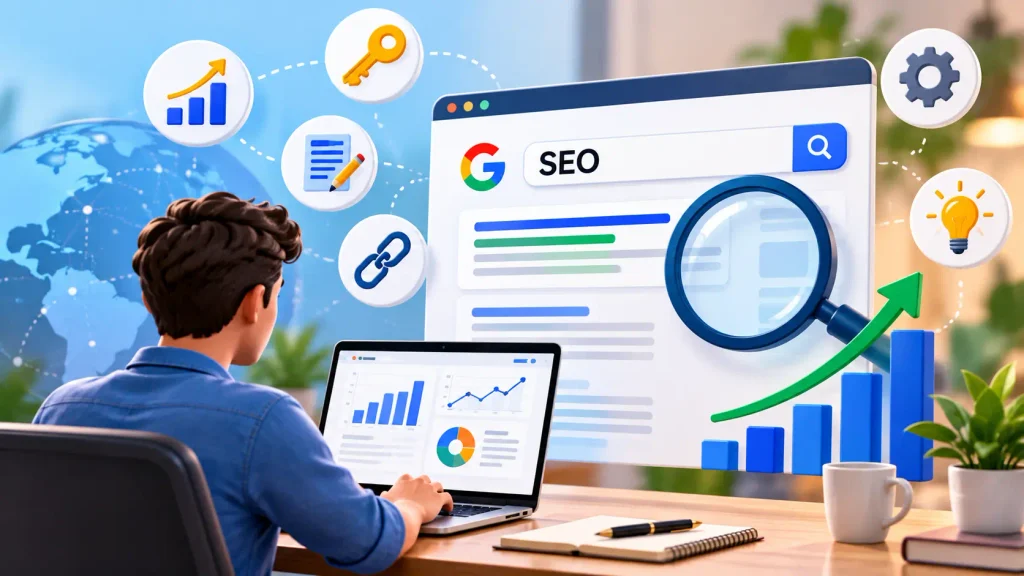
Why Is SEO Important?
Millions of people use search engines every day to find information, businesses, products, services, and answers to questions.
If your website cannot be found in search results, you could miss people who are actively interested in what you offer.
A strong search presence can bring visitors without requiring you to pay for every click. This is known as organic traffic.
Better search engine rankings can also increase the visibility of a business or website. However, ranking should not be the only goal. Your content should also satisfy the visitor once they arrive.
A page that attracts visitors but provides no useful information is unlikely to create lasting value.
What Are the Main Types of SEO?
Search engine optimization covers several areas. For beginners, it is useful to understand three main types: on-page, off-page, and technical optimization.
On-Page SEO
On-page optimization covers improvements made directly to individual pages.
Content is a major part of this process. Your website content should answer the questions people are searching for in a clear and useful way.
You can start with keyword research to understand the words and questions your audience uses. You can then include those keywords naturally in your content.
Other important on-page elements include headings, URLs, images, descriptions, and the title tag.
Images should also be optimized. Adding useful alt text can describe an image and improve accessibility while providing search engines with additional context.
You should also add relevant internal links. These links connect related pages on your own website and make it easier for both visitors and crawlers to discover other useful content.
Off-Page SEO
Off-page optimization involves signals and activities that happen away from your website.
Backlinks are one well-known example. A backlink is created when another website links to one of your pages.
Links can help search engines discover content and may contribute to how a page is understood. However, the quality and relevance of a link matter.
Getting links from unrelated or low-quality websites simply to increase the number of backlinks is not a good long-term strategy.
Businesses can also build online visibility through public relations, useful resources, partnerships, brand mentions, and other forms of digital marketing.
The focus should be on earning genuine attention rather than creating large numbers of artificial links.
Technical SEO
Technical optimization focuses on how a website works behind the scenes.
Even high-quality content may struggle if search engines cannot properly access the website.
Technical work can include improving page speed, fixing broken links, managing redirects, creating a sitemap, checking robots.txt files, improving site architecture, and making sure important pages can be crawled.
Your website should also be mobile-friendly. Many people browse the internet from smartphones, so pages should be easy to read and use on smaller screens.
A clean technical structure makes the experience better for visitors while helping search engines access your content.
How Do Keywords Help SEO?
Keywords tell you what people are interested in finding.
For example, someone learning about digital marketing might search for “what is SEO,” while another person may search for “how does search engine optimization work?”
Both searches are related, but they show slightly different intentions.
Keyword research helps you understand these differences.
However, you should never force a keyword into every paragraph. Write naturally and use related words where they make sense.
Modern search engines are much better at understanding context than they were years ago. A useful article should therefore focus on the overall topic instead of repeating one exact phrase.
What Is the Difference Between SEO and Paid Search?
SEO and paid search can both bring visitors from search engines, but they work differently.
Paid search involves advertisements. Businesses may pay to have ads displayed for certain searches. In many campaigns, advertisers pay when someone clicks an ad.
Organic optimization does not require a website owner to pay a search engine every time someone clicks a normal search result.
However, that does not mean it is completely free.
Creating content, conducting research, improving a website, fixing technical problems, and building a strong online presence all require time or resources.
Businesses often use both organic optimization and paid advertising as parts of a wider digital marketing strategy.
How Long Does SEO Take?
There is no single amount of time that applies to every website.
A new website may need time before it gains meaningful search visibility. An established website may see changes sooner in some situations.
Results can depend on competition, content quality, technical issues, existing visibility, backlinks, search demand, and many other factors.
For this reason, it is better to think of optimization as an ongoing process rather than a one-time task.
Publishing useful content consistently and maintaining a healthy website can support growth over time.
How to Make a Website More Search-Friendly
A good starting point is to understand your visitors.
Find out what questions they ask and what information they need. Then create pages that answer those questions directly.
Use clear headings and short paragraphs. Make important pages easy to reach through your navigation and internal links.
Write a descriptive title tag for each important page. Optimize images and include useful alt text where appropriate.
You should also check whether your pages load properly on desktop and mobile devices.
The aim is to create an optimized website that works well for both people and search engines.
Whether someone finds you through Google, Bing, or another search platform, the page should provide the information they expected to find.
Avoid Keyword Stuffing.
One of the most common mistakes beginners make is keyword stuffing.
Keyword stuffing means repeating the same word or phrase too many times in an attempt to improve rankings.
This can make an article difficult and unpleasant to read.
Instead, use your main keyword where it is genuinely useful. Include related terms and answer different questions connected to the main topic.
For example, an article about search optimization can naturally discuss organic traffic, keyword research, search results, content quality, links, crawling, and indexing without repeating one phrase in every sentence.
The goal is to write for real readers first.
SEO and the Future of Search
Search technology continues to change.
Traditional search engines are now being joined by AI-powered search tools and large language models that can help users find and understand information in different ways.
This makes useful content even more important.
Website owners should create original pages that clearly answer questions and provide genuine value. Content should be structured so that both people and automated systems can understand what the page is about.
The basic idea remains simple: create useful information, maintain a technically reliable website, and make your pages easy to discover.
Common SEO Mistakes to Avoid
Beginners sometimes focus too much on rankings and forget about users.
Avoid publishing weak articles simply to target a keyword. Do not copy content from other websites or add unrelated keywords to a page.
You should also avoid buying large numbers of poor-quality links, creating unnecessary duplicate pages, or ignoring technical problems.
Another mistake is expecting immediate results.
Improving visibility in the engine results pages on SERPs can take time. A results page SERP is competitive because many websites may be trying to answer the same query.
A sustainable strategy focuses on quality, relevance, accessibility, and continuous improvement.
Frequently Asked Questions
What is SEO?
SEO is the process of improving a website so search engines can discover, understand, and display its pages for relevant searches. It can help websites gain more organic visitors.
What does SEO stand for?
SEO stands for Search Engine Optimization. It includes content, technical improvements, keyword research, links, and other practices that can improve a website’s search visibility.
Is SEO free?
You do not normally pay a search engine for clicks from organic results. However, improving a website can require money and time for content creation, technical work, research, tools, and other services.
Does SEO help a website?
It can. Search optimization can make a website easier for search engines to discover and can increase its visibility for relevant searches. Results depend on the website, competition, content, technical condition, and strategy.
How hard is SEO for beginners?
The basic concepts are not too difficult to learn. Beginners can start with useful content, simple keyword research, clear headings, internal linking, and basic technical improvements. Advanced work can become more complex.
What is the key to good SEO?
There is no single secret. Useful content, clear site structure, good technical performance, relevant links, and a positive user experience all play important roles.
Can I rank a website by using more keywords?
Simply adding more keywords does not guarantee better rankings. Keywords should be used naturally. Your page should focus on answering the searcher’s question instead of repeating phrases.
How often should I update my website content?
There is no fixed schedule for every website. Update a page when information becomes outdated, when you can make it more useful, or when important details have changed. Avoid making meaningless changes only to make a page appear fresh.
Final Thoughts
Understanding what SEO is becomes much easier when you stop thinking about it as a trick for search engines.
At its core, search engine optimization is about making a website easier to discover, understand, and use.
Start with your audience. Learn what they are searching for, create genuinely useful content, organize your pages clearly, and maintain a website that works well across different devices.
Search engines and AI-powered technologies will continue to evolve. However, useful information and a good user experience remain strong foundations for long-term organic visibility.
Instead of chasing every new tactic, focus on building a website that deserves to be found.
12 Responses