Running an online store is not just about adding products and waiting for sales. People first need to find your products.
Many shoppers use Google and other search engines before making purchasing decisions. They search for products, compare options, read reviews, and look for useful information.
This is where e-commerce SEO can help.
So, what is e-commerce SEO?
E-commerce SEO is the process of improving an online store so its pages can appear for relevant searches. It includes keyword research, product optimization, category pages, technical SEO, content, and internal links.
A strong e-commerce SEO strategy can help an online store attract more organic traffic and reach people who are already interested in its products or services.
What Is E-Commerce SEO?
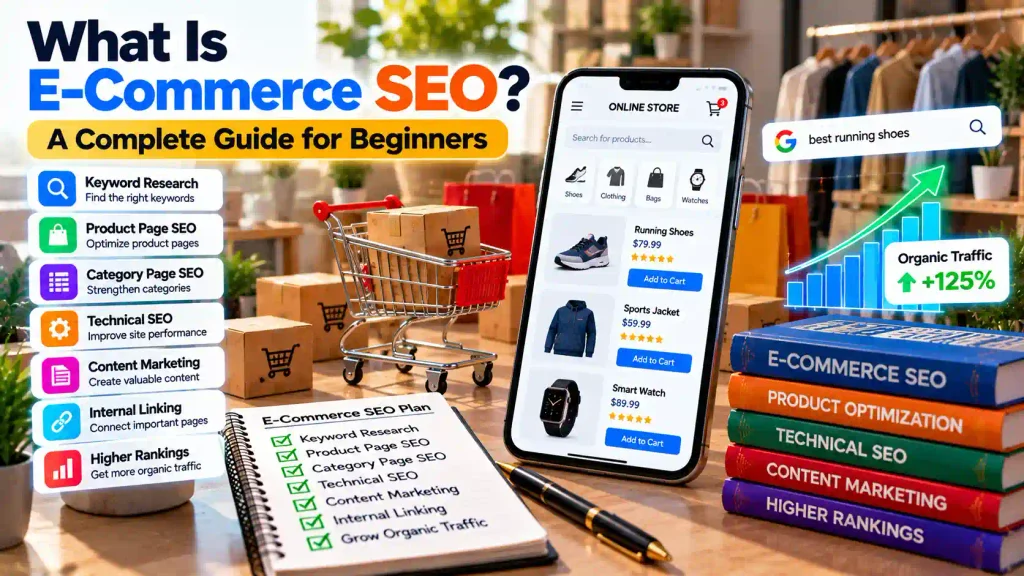
E-commerce SEO is a type of search engine optimization (SEO) made for online stores.
The goal is to make important store pages easier for search engines to crawl and understand. It also aims to make those pages useful for shoppers.
An e-commerce site may contain many types of pages, such as
- Product pages
- Category pages
- Brand pages
- Subcategory pages
- Blog posts
- Buying guides
- Comparison pages
- Landing pages
Each web page can serve a different purpose.
For example, someone searching for “running shoes” may still be comparing options.
Someone searching for “buy men’s black running shoes size 10” is looking for a much more specific product.
Good SEO considers these differences.
Why Is Ecommerce SEO Important?
Search engines can connect an online store with potential customers.
Imagine you sell office chairs.
A customer searches. Google for:
best ergonomic office chair for home
If your category, product, or buying guide appears for that search, the customer may discover your store.
Without good SEO, your products may be difficult to find through organic search.
Online store SEO can help you:
- Increase organic traffic
- Reach your target audience
- Improve product visibility
- Attract potential customers
- Support product discovery
- Increase brand awareness
- Reduce dependence on ads
- Build long-term search visibility
SEO does not guarantee a certain ranking or number of sales. But it can make relevant pages easier to discover.
Understand Your Target Audience
Before doing SEO, understand your target audience.
Ask simple questions:
Who buys your products?
What problems do they have?
What words do they use?
What information do they need before buying?
What questions do they ask?
Suppose you sell hiking shoes.
Your customers may search for:
- Best hiking shoes for beginners
- Waterproof hiking shoes
- Men’s hiking shoes
- Hiking shoes for rocky trails
- Lightweight hiking shoes
Understanding your audience helps you choose better keywords and create more useful pages.
Ecommerce Keyword Research
Ecommerce keyword research is one of the first steps in a good strategy.
It helps you discover the search queries people use when looking for your products.
Do not focus only on the official name of a product.
Customers may describe the same item in different ways.
For example, a clothing store might discover searches such as
- Men’s leather jackets
- Black leather jacket for men
- Affordable leather jackets
- Winter jackets for men
- Best leather jackets
- Buy a men’s leather jacket online
Each keyword may have different value and search intent.
What Is Search Intent?
Search intent is the reason behind a search.
It tells you what the user wants to do.
For e-commerce websites, there are several important types.
Informational Intent
The person wants to learn something.
Example:
How to choose running shoes
A guide or blog article may work well.
Commercial Intent
The person is comparing products.
Example:
Best running shoes for beginners
A comparison or buying guide may match this search.
Transactional Intent
The person may be ready to buy.
Example:
Buy Nike running shoes online.
A product or category page may be more suitable.
Understanding intent helps you match the right page with the right keyword.
This can improve your chances of ranking for relevant searches.
Use Long-Tail Keywords
Long-tail keywords are more specific searches.
For example:
Shoes are broad.
Women’s waterproof hiking shoes in size 7 are much more specific.
Long-tail keywords may have lower search volume. But they can show clearer buying intent.
This makes them useful for e-commerce stores.
Try to find keywords for:
- Products
- Categories
- Brands
- Product features
- Problems
- Comparisons
- Buying questions
Do not create pages only to repeat keywords. Every page should have a useful purpose.
Product Page SEO
Product page SEO focuses on improving individual product pages.
A product page should make it easy for both customers and search engines to understand the item.
Important elements include:
- Clear product name
- Useful title
- Original description
- Product images
- Price
- Availability
- Features
- Specifications
- Reviews
- Shipping details
- Internal links
Good page optimization is not about repeating a keyword many times.
It is about giving customers enough information to make a decision.
Write Better Product Descriptions
Avoid using a short manufacturer description on every store.
Write useful product descriptions when possible.
Explain:
- What the product is
- Who it is for
- Main features
- Size or dimensions
- Materials
- Benefits
- Important specifications
- How it can be used
For example, instead of writing:
High-quality office chair. Comfortable and modern.
Give the shopper useful details about support, materials, size, adjustment options, and suitable use cases.
Helpful information can also build trust with shoppers.
Optimize Product Titles
Product titles should clearly describe the item.
A title can include useful details such as
- Brand
- Product type
- Model
- Size
- Color
- Main feature
Do not stuff the title with every possible keyword.
Keep it clear for shoppers.
The title should help someone quickly understand what the page sells.
Category Page SEO
Category page SEO is also important.
Category pages group similar products together.
For example:
Shoes → Men’s Shoes → Men’s Running Shoes
This structure helps shoppers browse the store.
It can also help search engines understand the relationship between pages.
Category pages can often target broader commercial keywords.
A running shoe category might target a broader phrase such as
men’s running shoes
A product page can then target a specific product or model.
Optimize Category Pages
A useful category page may include:
- Clear heading
- Short category introduction
- Relevant products
- Filters
- Easy navigation
- Internal links
- Useful title and meta description
Do not add hundreds of words simply for SEO.
Category content should help users understand what they can find on the page.
Also pay attention to filters and sorting options. Large stores can create many URL variations through filters.
These URLs may need careful technical management.
Technical SEO for Ecommerce
Technical SEO is very important for large e-commerce websites.
Stores can have hundreds or thousands of URLs.
Products may also create filters, sorting pages, duplicate URLs, and old pages.
Technical problems can make it harder for search engines to crawl important content.
Key areas include:
- XML sitemaps
- Robots.txt
- Canonical tags
- HTTPS
- Redirects
- Broken links
- Site speed
- Mobile SEO
- Structured data
- URL structure
- Internal linking
Regular technical checks can help keep the site healthy.
Improve Website Speed
Shoppers do not want to wait a long time for a page to open.
A store may use many large product images, scripts, apps, and tracking tools. These can slow the site down.
Check how quickly important pages loaded for users.
You can improve performance by:
- Compressing images
- Using modern image formats
- Removing unused scripts
- Improving hosting
- Using caching
- Reducing unnecessary apps
Faster pages can create a better shopping experience.
Mobile SEO
Mobile SEO is essential for e-commerce.
Many shoppers browse and buy products on phones.
Your store should work well on small screens.
Mobile visitors should be able to:
- Browse categories
- Search for products
- View images
- Read descriptions
- Select options
- Add products to a cart
- Complete checkout
Buttons should be easy to tap.
Text should be easy to read.
A page should not require constant zooming.
Your SEO efforts should support both desktop and mobile users.
Product Schema and Structured Data
Structured data helps search engines understand certain information on a page.
For e-commerce stores, product schema can describe product information in a structured format.
Depending on the page and markup, this may include:
- Product name
- Brand
- Price
- Availability
- Ratings
- Reviews
Correct structured data can make eligible pages suitable for enhanced search results.
However, adding product schema does not guarantee special search features.
The information in your markup should also match what users can see on the page.
Internal Linking
Internal linking means linking from one page on your site to another.
This is especially useful for e-commerce stores.
For example:
A guide about choosing running shoes could link to your running shoe category.
A category page could link to important products.
A product page could link to related products or useful guides.
Internal links can help visitors discover more content.
They also help search engines find pages and understand the structure of your website.
Every important page on your site should be reasonably easy to discover.
E-commerce Content Marketing
Ecommerce content marketing can attract people before they are ready to buy.
Not every search is a product search.
People also ask questions.
A furniture store could publish:
- How to choose a dining table
- Best desk size for a home office
- Wood vs glass dining tables
- How to clean wooden furniture
- Small living room furniture ideas
These are different types of content that can reach users earlier in their buying journey.
Create Valuable Content
Valuable content answers real customer questions.
Do not publish blog posts simply because you need more pages.
Think about what helps your customers make better choices.
Useful ecommerce content can include:
- Buying guides
- Comparisons
- Tutorials
- FAQs
- Size guides
- Care guides
- Gift guides
- Product guides
This content can support product and category pages through internal links.
It can also bring informational organic traffic to your store.
Optimize Landing Pages
Ecommerce websites may also use landing pages for brands, product groups, seasonal collections, or campaigns.
Each landing page should have a clear purpose.
For example:
Summer Running Shoes
A page like this could collect products that match a seasonal search.
Avoid creating many thin landing pages that offer almost the same products and information.
Create a page when it provides a useful experience for the customer.
Avoid Duplicate Content
Duplicate content can become a problem on large ecommerce stores.
It may happen because of:
- Product variations
- Filters
- Sorting URLs
- Manufacturer descriptions
- Tracking parameters
- Similar categories
Do not panic if some duplicate URLs exist. Large stores naturally create similar pages.
However, important pages should have a clear purpose.
Canonical tags and other technical controls can help search engines understand preferred URLs where appropriate.
Handle Out-of-Stock Products Carefully
Products sometimes become unavailable.
Do not automatically delete every product page as soon as an item goes out of stock.
The right action depends on whether the product will return.
If it is temporarily unavailable, you may keep the page and clearly show its status.
If it is permanently discontinued, you may need to consider relevant alternatives, redirects, or removal depending on the situation.
The goal is to avoid sending customers to confusing or useless pages.
Link Building for Ecommerce
External links can support wider ecommerce SEO efforts.
Stores may earn links through:
- Digital PR
- Product reviews
- Industry publications
- Useful resources
- Original research
- Partnerships
- Relevant guest contributions
Focus on quality and relevance.
A useful mention from a relevant publication can be more meaningful than many random links from unrelated websites.
Measure Your Ecommerce SEO
SEO should be measured over time.
Useful data can include:
- Organic traffic
- Search impressions
- Search clicks
- Keyword visibility
- Product page traffic
- Category page traffic
- Conversions
- Revenue from organic visitors
Google Search Console can help you understand search performance.
Analytics tools can help you study what visitors do after reaching your store.
Use this information to improve future SEO efforts.
How to Start Ecommerce SEO for Beginners
You do not need to optimize the whole store in one day.
Start with the basics.
Step 1: Understand Your Audience
Learn what your potential customers want.
Step 2: Do Ecommerce Keyword Research
Find keywords for products, categories, and useful informational content.
Step 3: Improve Site Structure
Make categories and products easy to find.
Step 4: Optimize Important Product Pages
Improve titles, descriptions, images, and product information.
Step 5: Optimize Category Pages
Target useful commercial searches and improve navigation.
Step 6: Fix Technical Problems
Check speed, mobile usability, indexing, redirects, sitemaps, and structured data.
Step 7: Improve Internal Linking
Connect products, categories, guides, and other relevant pages.
Step 8: Create Helpful Content
Answer questions that customers ask before buying.
Step 9: Measure Results
Track organic traffic, rankings, clicks, and conversions.
Step 10: Keep Improving
SEO is a long-term process.
Continue updating pages as products, customers, and search behavior change.
Common Ecommerce SEO Mistakes
Avoid these common problems:
- Copying product descriptions
- Ignoring search intent
- Targeting only high-volume keywords
- Poor internal linking
- Slow product pages
- Ignoring mobile users
- Thin category pages
- Broken product URLs
- Keyword stuffing
- Incorrect structured data
- Creating too many weak pages
- Focusing only on rankings
Good ecommerce SEO should improve both search visibility and the shopping experience.
Frequently Asked Questions
What Is E-Commerce SEO?
E-commerce SEO is the process of improving an online store so its product pages, categories, content, and other pages can gain better visibility for relevant organic searches.
How Do I Start SEO for Beginners?
Start with your target audience and keyword research. Then improve your website structure, important pages, internal links, mobile experience, speed, and content.
Is SEO Paid or Free?
You do not pay a search engine for each organic SEO click. However, SEO may involve costs for tools, writers, developers, agencies, and other resources.
How Do I Learn Ecommerce SEO?
Learn basic SEO first. Then focus on ecommerce keyword research, product page SEO, category page SEO, technical SEO, product schema, structured data, internal linking, mobile SEO, and content marketing.
What Are the Top 5 SEO Tools?
Five commonly used tools are Google Search Console, Google Analytics, Ahrefs, Semrush, and Screaming Frog SEO Spider. They serve different purposes, including analytics, keyword research, backlinks, and technical audits.
What Is Product Optimization?
Product optimization means improving a product page so it is useful to shoppers and easier for search engines to understand. This can include titles, descriptions, images, specifications, structured data, and internal links.
Final Thoughts
So, what is e-commerce SEO?
It is the process of improving an online store for relevant organic searches.
A strong ecommerce SEO strategy combines ecommerce keyword research, product optimization, product page SEO, category page SEO, technical SEO, product schema, structured data, internal linking, ecommerce content marketing, and mobile SEO.
But SEO should not focus only on search engines.
Think about your customers too.
Create useful product information. Make categories easy to browse. Keep pages fast. Answer important questions. Help shoppers make better purchasing decisions.
When your store offers a good experience and your pages match the right search intent, your SEO strategy has a stronger foundation for attracting relevant organic traffic over time.